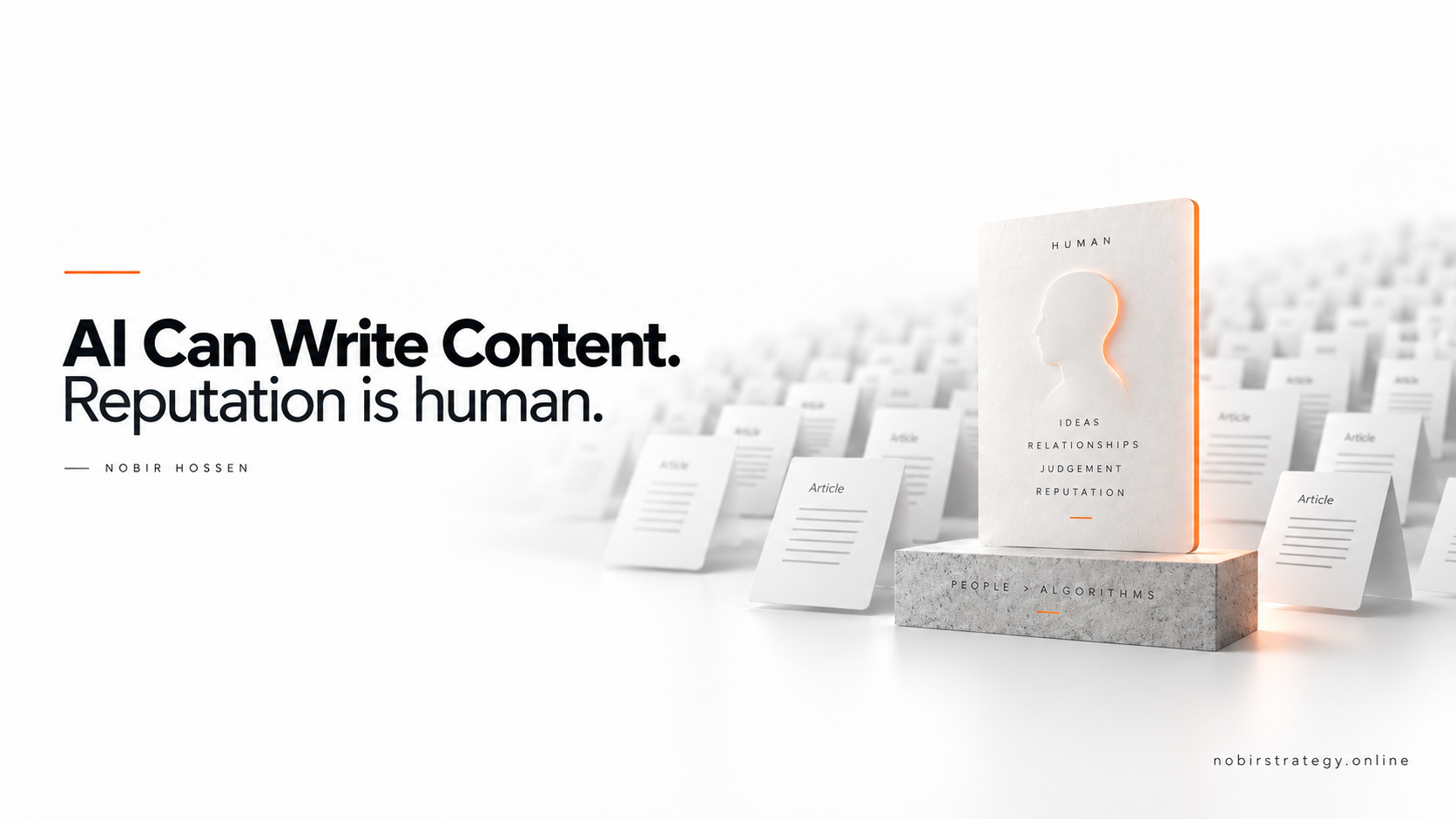
AI Can Write Your Content. It Cannot Build Your Reputation.
By Nobir Hossen, Social Media Marketing Strategist
AI has made competent content easier to produce.
Give a capable model a topic, audience, goal, a few reliable sources and enough context, and it can draft a respectable article in seconds.
Then it can turn that article into a LinkedIn post, a newsletter, a Facebook post, a carousel, ten hooks and a video script.
That is useful.
It also changes what makes content valuable.
For years, being able to write clearly, structure an argument and publish consistently created an advantage. Those skills still matter, but access to generative AI has lowered the production barrier.
So I think the more important question now is not:
Can AI create good content?
It can.
The harder question is:
If everyone can create good content, what becomes the competitive advantage?
My answer is:
The person behind it.
Experience.
Proof.
Point of view.
Judgment.
Relationships.
Reputation.
Trust.
AI can help communicate those things.
It can help organize them, challenge them, edit them and distribute them.
But it cannot simply generate the real-world history that makes them credible.
That is the part of content I think becomes more valuable as AI gets better.
Good content is becoming easier to produce
We already have evidence that generative AI can improve performance on some professional writing tasks.
In a randomized experiment published in Science, researchers Shakked Noy and Whitney Zhang studied 453 college-educated professionals completing occupation-specific writing tasks. Participants with access to ChatGPT finished the tasks about 40% faster on average, while independent evaluators rated their output quality about 18% higher.
That result has limits. It was a controlled experiment involving specific professional writing tasks. It does not mean AI makes every worker 40% faster or improves every piece of content by 18%.
But it demonstrates something important.
Generative AI can significantly reduce the effort required to produce competent written work.
Read the Noy and Zhang study record on PubMed
For content creators, consultants and businesses, the strategic consequence matters more than the exact percentage.
When production becomes easier, production alone becomes a weaker differentiator.
A clean article is no longer strong evidence that the author deeply understands the subject.
A polished LinkedIn post is not proof that the person has solved the problem they are discussing.
A professional-looking framework does not tell you whether anyone has ever tested it.
AI can produce all three.
This does not make content less valuable.
It changes where the value has to come from.
The dangerous middle is filling up
A lot of AI-assisted content is technically fine.
The grammar works.
The structure makes sense.
The headline is clear.
The advice sounds reasonable.
Nothing is obviously broken.
But remove the author's name and something strange happens.
The same article could have been published by a consultant in New York, an agency in London, a SaaS company in Singapore or a creator in Dhaka.
That is the problem.
Not that AI touched the article.
The problem is that there is often very little inside the article that belongs specifically to the person publishing it.
Recent research makes that concern harder to dismiss.
A 2026 study published in Nature Human Behaviour examined roughly 880,000 texts and found evidence that writing became less linguistically varied as LLM-assisted writing spread. The research also found that LLM rewriting could compress differences in writing style and some of the personal signals expressed through language.
Read the Nature Human Behaviour research briefing
That does not prove that everybody who uses AI will sound the same.
It does suggest a real risk.
If millions of people start with similar models, similar prompts, similar public sources and similar instructions such as “make this professional,” content can drift toward the statistical middle.
For a business or personal brand, being polished is therefore not enough.
You need to be identifiable.
30.8 million views taught me something the AI could not
One of the most useful lessons I have learned about content did not come from an AI prompt or a marketing book.
It came from looking at one of my own dashboards.
At one point, my content recorded 30.8 million organic views in 28 days.
That number looked great.
But the deeper lesson came from understanding what the number did not tell me.
30.8 million views did not mean 30.8 million people trusted me.
It did not mean every viewer understood what I could do for their business.
It did not mean millions of sales conversations.
It did not automatically create reputation.
The dashboard measured distribution.
It did not measure trust.
That distinction changed how I think about content.
A post can travel much further than the reputation of the person who created it.
You can win attention and still leave the buyer asking:
Who is this person?
What has he actually done?
Does he understand this problem beyond the post?
Can he show evidence?
Does his thinking survive when the answer is complicated?
Would I trust his judgment with my business?
Those questions happen after the impression, view or click.
This is why I no longer treat attention and authority as interchangeable.
Attention gets you noticed. Reputation gives that attention somewhere to go.
AI could help me tighten that sentence.
It could not give me the dashboard that made me understand it.
That difference matters.
If you want to see more of how I think about social media, content strategy and building systems around content rather than isolated posts, I publish those ideas on the Nobir Strategy Blog.
The best part of your content may be information AI never had
After an AI-assisted draft is finished, I think there is one question worth asking:
What can I add that the model could not have known unless I gave it the information?
That question immediately exposes generic content.
If everything inside an article came from information already available across Google, reports, Reddit discussions, existing blog posts and model training data, another person can probably create something very similar.
So give the model better raw material.
Give it what happened when you actually implemented the strategy.
Give it the campaign result.
The screenshot.
The failed experiment.
The unexpected customer objection.
The sales-call notes.
The decision you reversed.
The assumption that turned out to be wrong.
The pattern you noticed after doing the same type of work repeatedly.
The question customers keep asking that nobody in your industry seems to write about.
That material is harder to copy.
Not because the language is more sophisticated.
Because someone had to experience something before it could be written.
Consider the difference:
“Consistency is important for social media growth.”
There is nothing technically wrong with that sentence.
But almost anyone can write it.
Now compare it with:
“I have seen content generate tens of millions of views and still learned that reach alone cannot answer the questions a potential client asks before trusting someone with their business.”
The second statement contains history.
That is the layer AI cannot manufacture for you.
Claims became cheap. Proof did not.
AI has made it incredibly easy to sound experienced.
Anyone can publish:
“We use a data-driven strategy.”
“We build high-converting content.”
“We understand audience psychology.”
“We use a proven framework.”
“We help businesses build authority.”
Generating those sentences costs almost nothing.
Try replacing them with evidence.
Now things get harder.
Where is the data?
Where is the campaign?
What exactly changed?
What happened before and after?
What was measured?
What failed?
How long did the result last?
What other factors might have influenced it?
Now we are no longer talking about copywriting.
We are talking about proof.
And proof still costs something.
The work has to happen before the case study can exist.
The experiment has to run before you know what it taught you.
A client has to trust you before you can earn a genuine testimonial.
A decision has to be made before you can later explain why it succeeded or failed.
That leads to a rule I use when evaluating content:
The stronger the claim, the stronger the proof should be.
If I say my content recorded 30.8 million views in 28 days, I should be able to show the original dashboard.
If someone says a campaign doubled revenue, I want to know what revenue period they are comparing, what else changed and how attribution was determined.
If an article says “research proves,” I want to see the research.
If a statistic cannot survive one more click, it probably does not deserve to carry the argument.
Information is not the same as judgment
AI is exceptionally useful for information.
It can summarize options.
Compare frameworks.
Identify patterns.
Organize research.
Find counterarguments.
Explain concepts.
But valuable professional work often begins after the information has been gathered.
Imagine a founder asks:
Should I post on LinkedIn every day?
A model can generate a reasonable answer instantly.
A strategist should probably ask more questions first.
What are you selling?
Who needs to see the content?
Do you have enough original insight to publish daily?
Can you maintain the quality?
Is reach actually the bottleneck?
Are people already seeing your content but failing to understand your positioning?
Would three strong posts create more business value than seven average posts?
What happens if publishing more increases impressions but weakens the quality of the ideas people associate with your name?
Now the problem is different.
We are dealing with trade-offs.
Information tells you the available options.
Judgment tells you what to do when the options conflict.
That judgment develops through decisions.
Some work.
Some fail.
You notice patterns.
Reality changes your opinion.
Eventually, your value is not simply knowing the standard answer.
It is knowing when the standard answer does not fit the situation.
AI can make that judgment stronger.
I use AI to challenge assumptions, organize thinking, expose missing evidence and test an argument from another angle.
But there is an important difference between:
using AI to think better
and
asking AI to do all the thinking for you.
If every opinion begins and ends with the model, eventually the content may contain plenty of information but very little person.
Google is not simply asking, “Was this written by AI?”
This point matters because AI content and SEO are often discussed badly.
“Google hates AI content” is not an accurate summary of Google's published guidance.
Google currently says generative AI can be useful for tasks such as researching a topic and adding structure to original content.
Its warning is about generating many pages without adding value, particularly when automation is used in ways that violate its policies around scaled content abuse. Google also tells publishers to focus on accuracy, quality and relevance.
Google Search guidance on generative AI content
Google's broader people-first content guidance goes further.
It asks whether content contains original information, research or analysis.
Whether it adds substantial value rather than simply rewriting other sources.
Whether it demonstrates firsthand expertise.
Whether information is clearly sourced.
Whether readers can identify who created the content.
Google also explicitly states that E-E-A-T itself is not a specific ranking factor, although its ranking systems use signals related to experience, expertise, authoritativeness and trustworthiness.
Google's people-first content and E-E-A-T guidance
That distinction matters.
The goal is not to attach an author box because someone told you it is an SEO trick.
The goal is to make the real source of the information visible.
Not:
Did a human manually type every word?
A more useful question is:
Is there something real behind these words?
The five human layers I would not outsource to AI
This is the framework I would use before publishing any important AI-assisted content.
1. Firsthand experience
What happened to you, your business, your project or your client?
Show the reality behind the advice.
That may mean analytics, screenshots, results, observations or a failed decision.
My 30.8 million-view example belongs here.
It is not borrowed expertise.
It came from work I can trace back to an actual dashboard.
Google's own people-first guidance specifically asks whether content demonstrates firsthand expertise.
2. Something the AI could not know
Put information into the article that did not originate from generic public knowledge.
A customer conversation.
A campaign insight.
An internal process.
Proprietary data.
A decision.
An unexpected failure.
A pattern from your own work.
If another website could replace your name with theirs and publish the entire article unchanged, there is probably not enough of you inside it.
3. Ruthless editing
Delete the sentences that exist only because the draft feels like it should contain them.
“In today's fast-paced digital landscape…”
Gone.
“Businesses must leverage the power of AI…”
Gone.
“AI is changing the way we work…”
Unless the next sentence tells me exactly how, cut it.
Every sentence spends some of the reader's attention.
Make it earn that attention.
Specific nouns beat empty adjectives.
Evidence beats “proven.”
A number beats “massive.”
An example beats “innovative.”
Sometimes three sentences are better than three paragraphs.
4. Human verification
AI can help research.
It cannot be the final authority for a claim simply because the answer sounds convincing.
Open the original source.
Check the publication date.
Read what was actually measured.
Look at the sample.
Check whether the result was correlation or causation.
Confirm whether a statistic refers to consumers, marketers, executives, one country or a global sample.
Follow the citation.
Check that the page still exists.
This article is a good example.
I could write:
“Research proves AI makes workers 40% more productive.”
That would be stronger language.
It would also be inaccurate.
The actual Noy and Zhang research studied 453 college-educated professionals performing specific writing tasks. Their average completion time fell by 40% and evaluated quality increased by 18%. That is the claim the evidence supports.
Precision is not weaker writing.
It is more trustworthy writing.
5. Real accountability
Put a real person behind the article.
A real name.
A real photograph.
Relevant experience.
Links to real work.
A way to inspect that person's thinking beyond one article.
Google strongly encourages accurate authorship information such as bylines when readers would reasonably expect it. Its guidance also says that explaining how automation or AI contributed can give readers useful context when such disclosure is relevant.
But I think the principle matters beyond SEO.
If something in this article is wrong, my name is attached to it.
You can inspect the source.
Challenge the argument.
Compare this article with my other work.
That accountability is part of reputation.
The model does not carry it.
The author does.
Fact-checking is part of your brand
AI lowers the cost of creating a confident claim.
Unfortunately, it can also lower the cost of creating a confident mistake.
An outdated statistic does not become current because an AI rewrote it beautifully.
A secondary article does not become a primary source because five other articles cited it.
A correlation does not become causation because the paragraph sounds authoritative.
And a source that looks believable is not evidence until it actually exists.
So the final step of an AI content workflow should never be:
The draft looks good. Publish.
Check it.
Open the research.
Check dates.
Check context.
Check the wording of the original claim.
Remove numbers you cannot verify.
Replace secondary sources with primary sources where possible.
Update links.
And if the evidence does not support the most impressive sentence in your draft, delete the sentence.
I would rather attach my name to a smaller claim I can defend than a dramatic claim I cannot.
That decision is invisible in most analytics dashboards.
But repeated over time, it becomes reputation.
Reputation cannot be generated in one prompt
You cannot prompt:
“Build me five years of client trust.”
You cannot generate a long working relationship in thirty seconds.
You cannot manufacture a history of making difficult decisions.
You cannot create genuine word of mouth by writing “trusted by industry leaders” on a landing page.
Reputation accumulates.
Someone sees one piece of content.
Then another.
They visit your profile.
They look at your work.
They read your thinking.
Maybe they see your name mentioned somewhere else.
They notice whether your claims stay consistent.
They watch how you respond when somebody disagrees.
They see whether the work behind the content exists.
Then, eventually, they might start a conversation.
Analytics often credit the final click because it is measurable.
Human trust may have been developing long before that click happened.
Content participates in the process.
Content is not the whole process.
Your behaviour matters.
Your results matter.
Your relationships matter.
Your consistency matters.
Other people's experiences with you matter.
Together, those things create the reputation surrounding your name.
For more of my work and thinking around content strategy, positioning and social media systems, you can explore Nobir Strategy and the Nobir Strategy Blog.
Use AI heavily. Just do not let it become the source of everything
I am not arguing for human-only content.
That would ignore how useful these tools have become.
Use AI for research.
Use it to challenge your argument.
Use it to find questions you forgot to answer.
Use it to organize your notes.
Use it to identify weak logic.
Use it to edit.
Use it to tighten a draft.
Use it to turn a strong article into a LinkedIn post, Facebook post, newsletter, carousel or script.
Let AI multiply good thinking.
But give it raw material worth multiplying.
Your customer conversations.
Your experiments.
Your mistakes.
Your screenshots.
Your decisions.
Your original research.
Your actual observations.
Your disagreements.
Your results.
Your point of view.
Your experience.
Then use the machine to make the signal clearer.
Do not use it to invent the signal.
The strongest model I see is simple:
Human experience. Human evidence. Human judgment. Human accountability. AI leverage.
That order matters.
The competitive advantage is moving behind the content
The internet does not have a shortage of sentences anymore.
That changes the game.
Publishing volume is easier to manufacture.
Polished writing is easier to manufacture.
Professional formatting is easier to manufacture.
Even a sophisticated-sounding argument can be generated surprisingly quickly.
So the signals behind the content become more important.
What have you actually done?
What did it teach you?
What can you prove?
What do you see differently because of your experience?
When do you disagree with the standard advice?
Why?
What happens when the information is incomplete?
Can you make a judgment?
Can you admit when the evidence changes your mind?
Do clients trust you after the sale, not just before it?
Do your claims survive inspection?
That is where differentiation increasingly lives.
AI can help me write about 30.8 million views.
It cannot go back and create the work that produced those views.
It can help me explain why attention and trust are different.
It cannot create the experience that taught me the distinction.
It can improve this article.
It cannot make my reputation true.
That still has to be earned.
So when everyone has access to tools capable of producing good content, the sustainable advantage is not simply producing more content.
It is becoming someone whose content has something real behind it.
AI can write your content.
Your reputation is still your responsibility.
About the Author
Nobir Hossen is a Social Media Marketing Strategist focused on content strategy, social media growth, personal branding and building content systems that connect attention with trust and business outcomes.
His hands-on work with organic social content includes a 28-day period in which his content recorded 30.8 million views. He writes about social media strategy, AI-assisted content creation, audience psychology, positioning and the systems behind content that performs.
Explore more insights at Nobir Strategy or read the latest articles on the Nobir Strategy Blog.
Sources & Further Reading
Noy, S. & Zhang, W. “Experimental evidence on the productivity effects of generative artificial intelligence.” Science, 2023. The experiment involved 453 college-educated professionals and examined ChatGPT's effects on defined professional writing tasks.
PubMed / National Library of Medicine
Sourati, Z. et al. Research on linguistic diversity and LLM-assisted writing, Nature Human Behaviour, published August 2026.
Google Search Central. Guidance on using generative AI content on websites. Google says generative AI can support research and structure, while scaled low-value content can violate its spam policies.
Google Search Central: Generative AI Content Guidance
Google Search Central. Guidance on helpful, reliable, people-first content, including original information, firsthand expertise, authorship, E-E-A-T and AI-assisted creation.