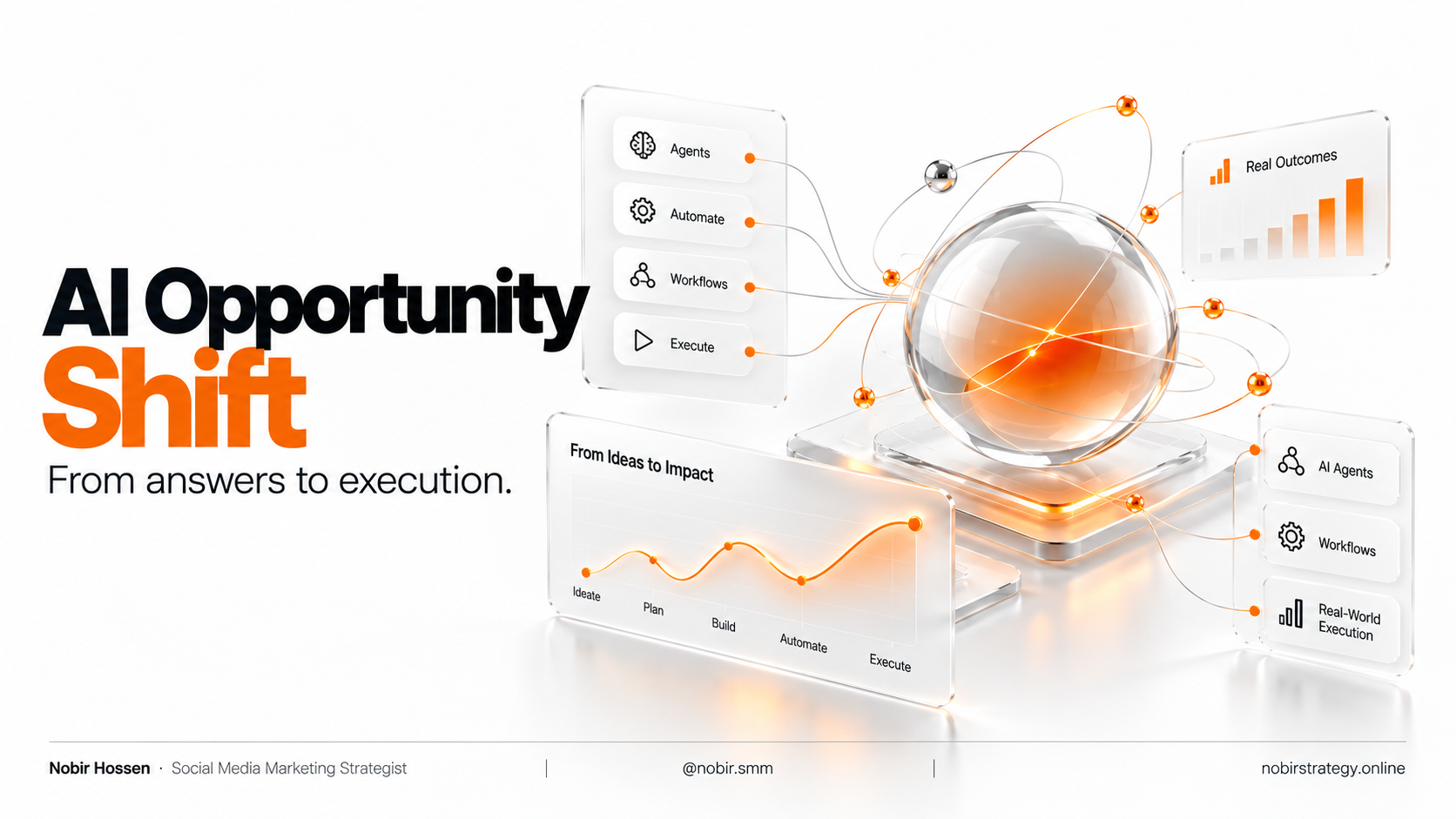
The AI Opportunity Shift: Why Execution Matters More Than Prompts
For the last few years, most conversations about AI started with one question:
What can this model generate?
In 2026, a more important question is emerging:
What can this system actually do?
That difference matters.
The biggest AI opportunity is shifting from better prompts and faster content generation toward agents, automated workflows, computer use, cybersecurity, business implementation and systems that can move from a goal to a finished outcome.
This shift was one of the strongest themes I took away from a recent discussion featuring OpenAI co-founder Greg Brockman.
The message is not that every job will disappear or that AI can already run every business by itself.
The more practical conclusion is this:
AI is becoming capable enough to execute larger parts of real workflows, while most businesses still do not know how to redesign their operations around that capability.
That gap is where a significant part of the opportunity exists.
The Quick Answer
What is the biggest AI opportunity in 2026?
It is the gap between what modern AI systems are capable of doing and what businesses have successfully implemented.
The strongest opportunities are emerging around AI agents, workflow automation, computer-use systems, vertical AI products, cybersecurity, AI implementation, research acceleration and services that combine AI capability with human judgment, domain expertise and distribution.
AI Is Moving From Assistance to Execution
The first era of generative AI was dominated by assistance.
Write this email.
Summarize this document.
Generate some ideas.
Create a social media post.
Explain this concept.
Those use cases are still valuable, but the technology is moving further.
OpenAI describes a similar transition in its enterprise research as a move from assistance toward execution. Its 2026 Enterprise Signals work suggests that more advanced organizations are increasingly connecting AI systems to company context, tools and repeatable workflows rather than using AI only as a standalone chatbot.
This is an important distinction.
An assistant helps you complete a task.
An agentic workflow can potentially take responsibility for multiple steps inside the task.
For example, instead of asking AI to write a sales follow-up message, an agentic system could review a lead, collect relevant context, classify the opportunity, draft the message, update a CRM and route the task for human approval.
That is a different economic model.
The value is no longer just faster content generation.
The value is workflow compression.
Opportunity 1: AI Agents and Workflow Automation
Many businesses still run on repetitive human coordination.
Someone copies information from one tool to another.
Someone checks a spreadsheet.
Someone researches a prospect.
Someone summarizes customer feedback.
Someone manually prepares the same weekly report.
Someone follows up on a missed task.
Someone opens multiple systems just to understand what happened.
These workflows are expensive not because every individual task is difficult, but because thousands of small tasks consume time, attention and operational energy.
AI agents create an opportunity to redesign these processes.
OpenAI currently describes workspace agents as systems capable of handling repeatable workflows, working across connected tools, running scheduled tasks and completing multi-step work with approval checkpoints where necessary.
This does not mean every workflow should be fully autonomous.
In many business environments, the smarter model is:
AI handles repetitive execution.
Humans define goals, permissions and quality standards.
Sensitive actions require approval.
Important outcomes are reviewed.
Performance is measured and improved.
The opportunity for marketers, consultants, operators and automation specialists is not simply to sell “AI automation.”
It is to identify where a business is losing time, money or consistency and redesign that workflow responsibly.
Opportunity 2: Computer-Use AI Expands What Can Be Automated
Traditional automation often depends on APIs.
If Software A and Software B expose the right integrations, developers can connect them.
But enormous parts of the digital world still operate through graphical interfaces.
Buttons.
Forms.
Dashboards.
Menus.
Web applications.
Legacy software.
That is why computer-use AI matters.
Modern computer-use systems can interpret interfaces and interact with browser or desktop environments. OpenAI’s computer-use documentation describes agents that can navigate websites, interact with applications and perform tasks through user interfaces.
This dramatically expands the number of workflows that can potentially be automated.
A company no longer needs every tool to provide the perfect API before AI can assist with a workflow.
However, computer-use agents also introduce risk.
A system that can click buttons and modify data needs permission boundaries, monitoring, approval rules and clear recovery procedures.
The opportunity is therefore not “let AI click everything.”
The opportunity is building reliable systems where AI can operate inside controlled environments while humans retain accountability.
Opportunity 3: AI Implementation Will Become a Valuable Business Skill
Many companies already know AI matters.
Their problem is not awareness.
Their problem is implementation.
They do not know which workflow should be automated first.
They do not know where AI can create measurable return.
They do not know which data the system needs.
They do not know what should remain human-controlled.
They do not know how to evaluate quality.
They do not know how to connect AI with their existing tools.
They do not know how to measure whether an AI project is actually improving the business.
This creates a practical service opportunity.
Businesses need people who can translate between:
Business problems
Customer needs
Processes
Data
AI capabilities
Automation
Risk
Measurement
That role might be called AI strategist, automation consultant, AI implementation specialist, operations strategist or something entirely different.
The label matters less than the capability.
The market needs people who can turn AI from a demo into an operating system for useful work.
Opportunity 4: Vertical AI May Be More Valuable Than Another Generic AI Tool
There is another important shift happening.
As frontier AI models become widely available, simply having access to a powerful model becomes less differentiated.
The advantage increasingly moves toward context.
Who understands the customer?
Who understands the workflow?
Who owns useful proprietary information?
Who knows where the bottleneck occurs?
Who can design a better user experience?
Who can distribute the product?
Who can build trust?
This is why vertical AI products are interesting.
Instead of building “AI for everyone,” founders can build solutions for specific workflows.
AI for accounting operations.
AI for legal workflows.
AI for agency reporting.
AI for customer support.
AI for healthcare administration.
AI for sales research.
AI for recruiting operations.
AI for marketing teams.
AI for creator businesses.
AI for cybersecurity.
The model may be similar.
The workflow knowledge is not.
The more deeply a product understands a real industry problem, the harder it becomes to replace with a generic chatbot.
Opportunity 5: Small Teams Can Gain More Leverage
AI is also changing the economics of starting and operating a business.
Historically, executing an idea might require separate people for research, development, design, writing, customer support, operations and analysis.
AI does not eliminate the need for expertise, but it can increase how much a small team is capable of producing.
A founder can research faster.
A strategist can analyze more information.
A developer can write and review more code.
A marketer can test more variations.
An operator can automate routine administration.
A creator can transform one strong idea into multiple useful formats.
This creates an interesting opportunity for small businesses, specialist agencies, micro-SaaS companies and focused service businesses.
The important word is leverage.
AI does not automatically make a bad business good.
It gives capable people more leverage.
If the customer problem is weak, more AI will not fix it.
If the positioning is unclear, faster production may only create more noise.
If there is no distribution, building faster does not guarantee demand.
Technology reduces some execution constraints.
Business fundamentals still matter.
Opportunity 6: Cybersecurity May Become One of the Most Important AI Markets
Cybersecurity is one of the areas where AI creates both major opportunity and major risk.
In August 2026, Greg Brockman described what he called “The Defender’s Window.”
His argument was that AI systems are increasingly capable of automating parts of real cyberattacks, but those same capabilities can help defenders identify and fix weaknesses.
Brockman shared a concrete example involving his own website.
According to his account, he asked ChatGPT Work to assess the security of his personal website. It identified 13 issues in roughly 15 minutes. He then used the system to help remediate the problems, including work involving DNS, TLS, outdated dependencies and security configuration.
This is a useful example because it demonstrates a broader pattern.
AI can potentially help defenders:
Find vulnerabilities.
Review configurations.
Analyze code.
Validate patches.
Investigate incidents.
Prioritize security issues.
Automate parts of remediation.
But the same underlying capabilities can also increase offensive capacity.
That makes cybersecurity one of the clearest examples of why AI implementation requires governance, monitoring and responsible access.
The opportunity is real.
The risk is real too.
Opportunity 7: AI Will Accelerate Research and Knowledge Work
AI is not limited to administrative automation.
OpenAI reported in September 2026 that coding agents were already changing how researchers inside the company worked, including helping researchers write more code and run more experiments.
This should be interpreted carefully.
It does not mean AI has replaced scientists.
It does suggest that certain parts of research can be accelerated when models help with coding, experimentation, analysis and verification.
The same idea can extend beyond frontier AI labs.
Researchers, analysts, strategists and knowledge workers increasingly have tools that can help them explore information, test assumptions, generate alternatives and execute technical work faster.
This creates another important shift.
The value of expertise may move away from simply producing the first draft of work and toward deciding:
Which question matters?
Which evidence is reliable?
Which assumption is weak?
Which result should be trusted?
What should be tested next?
Where could the system be wrong?
AI increases output.
Human judgment decides what deserves attention.
Opportunity 8: Human Judgment Becomes More Valuable, Not Less
One of the weakest ways to think about AI is to divide the world into two camps.
AI replaces humans.
Or:
AI changes nothing important.
Both views miss the real transition.
AI changes the value of different kinds of work.
The World Economic Forum’s Future of Jobs research has repeatedly highlighted rising demand for technological skills alongside human capabilities such as analytical thinking, creativity, resilience, leadership and collaboration.
The 2026 Stanford AI Index also offers an important reality check.
Organizational AI adoption is high, but agent deployment across business functions is still relatively early.
That matters because it separates capability from implementation.
A technology can improve very quickly while business adoption remains uneven.
This means the next few years may reward people who can operate between technology and reality.
People who understand:
Customers.
Markets.
Strategy.
Systems.
Communication.
Risk.
Design.
Distribution.
Decision-making.
Taste.
Trust.
The AI can generate 50 options.
Someone still needs to know which one is worth pursuing.
What This Means for Marketers, Strategists and Service Businesses
For marketers, the opportunity is much larger than AI-generated content.
Content generation is becoming easier.
That means content production alone becomes less defensible.
The higher-value opportunities sit further upstream and downstream.
Audience understanding.
Positioning.
Offer design.
Research.
Customer insight.
Content systems.
Distribution.
Lead qualification.
Sales enablement.
CRM workflows.
Reporting.
Personalization.
Testing.
Measurement.
Customer retention.
AI can assist with many of these layers, but connecting them into a business system requires strategic thinking.
The marketer of the future should not ask:
How can I create 100 posts with AI?
A stronger question is:
How can I use AI to understand the customer better, improve decision-making, create stronger communication, reduce operational friction and move qualified buyers through the business more effectively?
That is a much more valuable problem.
Do Not Wait Until You Feel Like an AI Expert
There is a trap in fast-moving technology markets.
People wait for the perfect course.
The perfect roadmap.
The perfect tool.
The perfect moment.
Then the technology changes again.
A better approach is practical experimentation.
Choose one real problem.
Map the current workflow.
Identify the expensive or repetitive parts.
Decide where AI could assist.
Define what still needs human approval.
Build the smallest useful version.
Test it.
Measure the result.
Find the failure points.
Improve the workflow.
Repeat.
You do not need to predict the entire future of AI.
You need to learn how to create useful outcomes with the capabilities that exist now.
The Real AI Opportunity
The next AI advantage will probably not belong to the person who memorizes the most tools.
Tools change too quickly.
The stronger advantage is a system of thinking:
Problem → Context → AI Capability → Workflow → Human Judgment → Distribution → Measurement → Business Value
That sequence is more durable.
AI makes execution cheaper.
It makes experimentation faster.
It increases individual leverage.
But it does not remove the need to understand people, markets, trust, risk or economics.
The opportunity is not simply to use AI.
The opportunity is to connect AI to something that genuinely matters.
Frequently Asked Questions
What is the biggest AI opportunity in 2026?
One of the biggest opportunities is converting AI capability into reliable business workflows. Areas with strong potential include AI agents, workflow automation, computer use, cybersecurity, vertical AI products and AI implementation services.
Are AI agents already ready for businesses?
AI agents are already being used for real workflows, but reliability varies by task. Sensitive or high-impact workflows still need appropriate permissions, human approval, monitoring and evaluation.
Will AI replace marketers and strategists?
AI can automate parts of research, production, analysis and execution. However, customer understanding, strategic judgment, positioning, trust, creative direction and business decision-making remain important human responsibilities. The role is more likely to change than remain static.
What skills should professionals learn for the AI economy?
AI literacy matters, but it is more useful when combined with business fundamentals, workflow design, data literacy, automation, domain knowledge, analytical thinking, communication and judgment.
Is AI automation only for large companies?
No. Small businesses and individual operators can also use AI to reduce repetitive work, improve research, create systems and increase operating leverage. The right starting point is usually a specific workflow with a measurable problem, not automation for its own sake.
Why is cybersecurity an important AI opportunity?
AI can help defenders identify vulnerabilities, review configurations, analyze incidents and support remediation. At the same time, similar capabilities can increase offensive cyber capacity, which makes defensive security and responsible deployment increasingly important.
WATCH THE ORIGINAL VIDEO
This article was inspired by the discussion in the following video. The video provides additional context around AI capability, execution, opportunity and the direction of increasingly capable AI systems.
YouTube video:
https://www.youtube.com/watch?v=qy8Gr27yLMk
FINAL THOUGHT
The AI transition is not only about smarter models.
It is about what happens when increasingly capable systems are connected to tools, workflows, businesses and real-world decisions.
That creates enormous opportunity.
It also creates responsibility.
The people who build durable value will not simply ask what AI can generate.
They will ask what problem is worth solving, how the system should work, where human judgment belongs and how that solution creates measurable value.
ABOUT THE AUTHOR
Nobir Hossen is a Social Media Marketing Strategist focused on content systems, social media strategy, AI-powered marketing, positioning, audience psychology and turning attention into measurable business outcomes.
SOURCES AND FURTHER READING
OpenAI, The Defender’s Window, Greg Brockman, August 2026.
OpenAI, From Assistance to Execution: How Enterprises Put AI to Work, August 2026.
OpenAI, How AI-Native Companies Turn Workflows Into Operating Capability, September 2026.
OpenAI, Research Acceleration: The View Inside OpenAI, September 2026.
OpenAI, Computer Use documentation.
Stanford Institute for Human-Centered AI, The 2026 AI Index Report.
World Economic Forum, Future of Jobs Report 2025.