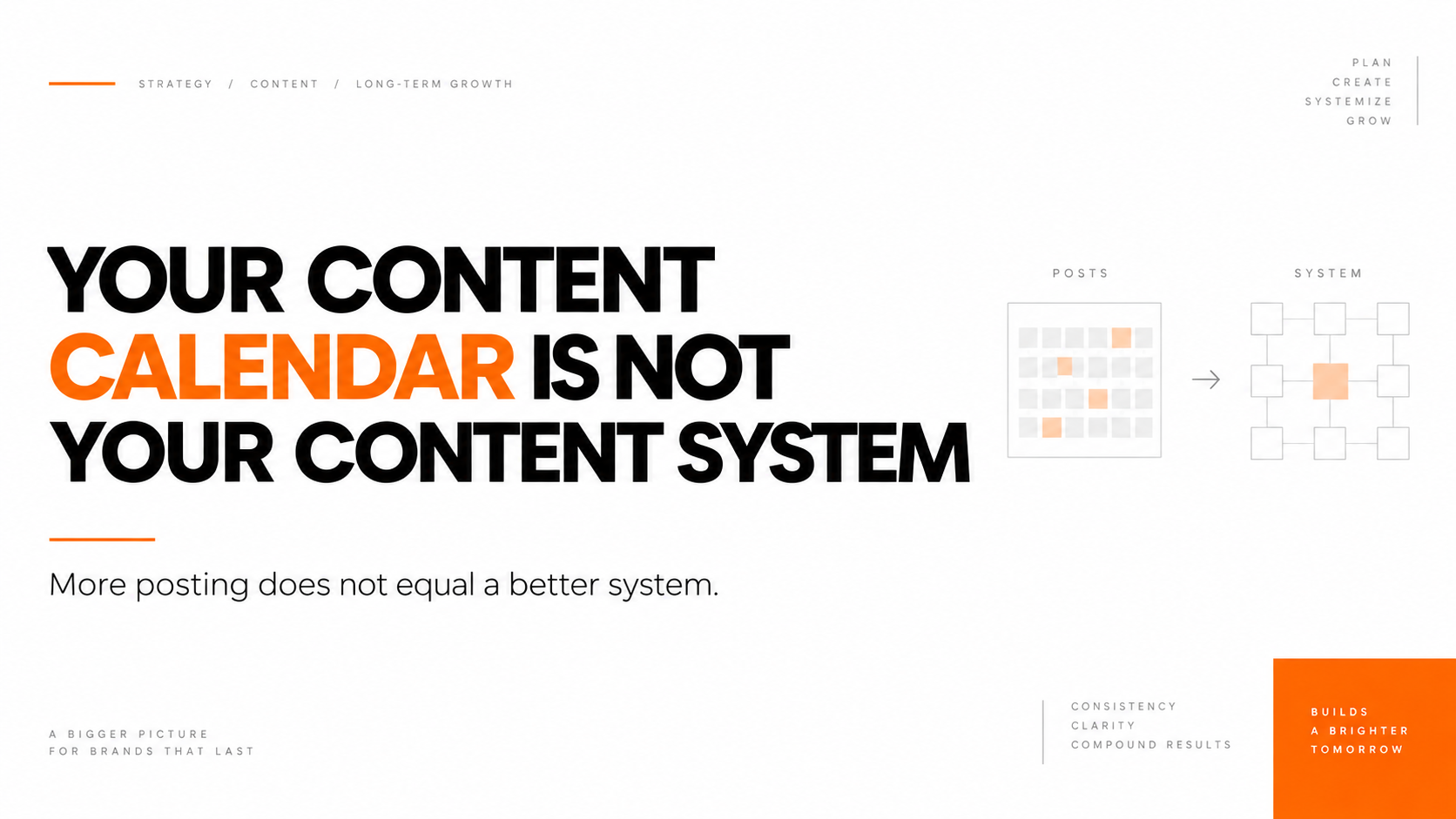
Your Content Calendar Might Be Full. Your Content System Might Still Be Broken.
Open the content calendar of almost any active brand and it looks productive.
Monday: educational post.
Tuesday: Reel.
Wednesday: carousel.
Thursday: founder story.
Friday: promotional post.
Everything has a date.
Everything has a format.
Everything looks organized.
Then ask one uncomfortable question:
Why are we publishing this particular piece of content?
The room often gets quieter.
Ask another:
What did we learn from last month's content, and how did that learning change what we are publishing this month?
Even quieter.
This is where the difference between a content calendar and a content operating system becomes important.
A calendar can organize activity.
A system organizes decisions.
And in a market where brands can now produce more content than ever before, better organization of posts is no longer enough.
The real advantage is knowing what deserves to be created, why it matters, how it connects to the audience, how it moves through production, what happens after publishing, and what the team learns before the next piece is made.
I often describe my approach to content with one line:
"Your content is not the problem. The system behind it is."
Nobir Hossen
That distinction matters more today than it did a few years ago.
Because AI made production faster.
It did not automatically make strategy better.
First, What Is a Content Calendar?
A content calendar is a planning tool used to organize content around dates.
At its simplest, it answers questions like:
- What are we publishing?
- When are we publishing it?
- Where are we publishing it?
- What format are we using?
- Who is responsible for it?
A typical calendar might contain columns for:
| DateTopicPlatformFormatStatus | ||||
| Monday | Industry mistake | Text post | Scheduled | |
| Tuesday | 3 marketing tips | Carousel | Design | |
| Wednesday | Client story | Image post | Draft | |
| Thursday | Quick tutorial | TikTok | Video | Editing |
| Friday | Service offer | Static image | Approved |
There is nothing wrong with this.
In fact, calendars are useful.
They help teams see upcoming work.
They reduce last-minute posting.
They make deadlines visible.
They prevent five people from asking, "What are we posting tomorrow?"
The problem starts when the calendar becomes the entire strategy.
A Full Calendar Can Create a False Sense of Progress
There is something psychologically satisfying about filling boxes.
Monday has a post.
Tuesday has a Reel.
Wednesday has a carousel.
Everything is green.
Everything says "Scheduled."
It feels like marketing is working.
But content activity and content effectiveness are two different things.
A team can publish 30 pieces of content in a month and learn almost nothing.
Another team can publish 12 pieces and become dramatically better at understanding:
- what their audience actually cares about
- which problems trigger conversations
- which ideas earn saves
- which opinions create trust
- which content drives profile visits
- which posts lead people toward services
- which topics attract the wrong audience
- which formats are worth repeating
That second team may publish less.
But its system is learning.
And a system that learns becomes more valuable over time.
So What Is a Content Operating System?
A content operating system, or Content OS, is the complete process that connects content strategy, audience intelligence, idea development, production, publishing, distribution, measurement, learning and business outcomes.
The calendar is one component inside it.
Think of it this way.
A calendar says:
Publish this post on Tuesday.
A content operating system asks:
Why this topic? Why this audience? Why this format? Why Tuesday? What business objective does it support? What happened the last time we discussed this subject? What signal will determine whether we repeat, improve or kill the idea?
That is a very different level of thinking.
A useful Content OS might look like this:
Audience Signal → Strategic Decision → Idea → Production → Distribution → Performance → Feedback → Learning → Next Decision
Then the loop repeats.
Not randomly.
Not because somebody suddenly needs "five posts for next week."
The system feeds itself.
Content Calendar vs Content Operating System
Here is the simplest comparison.
| Content CalendarContent Operating System | |
| Organizes posts | Organizes the entire content operation |
| Focuses on dates | Focuses on decisions and outcomes |
| Tells you what is coming | Tells you why it should exist |
| Tracks publishing | Tracks the entire lifecycle |
| Usually ends after posting | Continues after publishing |
| Helps maintain consistency | Helps improve effectiveness |
| Stores planned topics | Stores insights and audience signals |
| Measures output | Connects output with performance |
| Often static | Continuously learns |
| Useful for scheduling | Useful for scaling |
| Answers "When?" | Answers "Why, what, how, when and what next?" |
One is not the enemy of the other.
The calendar belongs inside the operating system.
The mistake is treating the calendar as if it were the system.
The Restaurant Analogy
Imagine running a restaurant.
A content calendar would be similar to having a reservation book.
It tells you:
7:00 PM, table four, two guests.
7:30 PM, table six, four guests.
Useful?
Absolutely.
But could you operate the entire restaurant with the reservation book?
Of course not.
You also need:
inventory,
suppliers,
recipes,
staff roles,
food preparation,
quality control,
customer feedback,
cost management,
cleaning procedures,
service standards,
sales data.
The reservation book is one part of the operation.
Your content calendar works the same way.
Yet many businesses are effectively trying to run their entire content department from the reservation book.
Why This Difference Matters More Now
Content production has become dramatically easier.
A marketer can brainstorm dozens of topics quickly.
A founder can generate drafts.
Design tools can produce visual variations.
Video workflows are becoming faster.
AI can assist with research, transcription, repurposing, editing and production.
This sounds like a huge advantage.
And it can be.
But faster production creates a new problem:
It becomes easier to produce content that never needed to exist.
You can now scale the wrong idea faster.
You can publish weak positioning more consistently.
You can create 50 posts without building 1 useful feedback loop.
The production bottleneck is shrinking.
The decision-making bottleneck is becoming more visible.
That changes the game.
The question is no longer simply:
Can we create enough content?
For many teams, the better question is:
Can we create a system intelligent enough to decide what content is worth creating?
More Posting Is Not the Same as a System
This is the mistake I see repeatedly.
A brand decides it needs more growth.
So the first response is:
"Let's increase posting frequency."
Three posts become five.
Five become seven.
One platform becomes three.
The team starts producing more.
But the underlying logic remains unchanged.
There is no stronger audience research.
There is no improved positioning.
There is no topic scoring.
There is no measurement framework.
There is no documented learning.
There is no connection between one month's performance and the next month's strategy.
The machine is moving faster.
It is simply not getting smarter.
That is not scale.
That is volume.
The Missing Piece: Feedback Loops
This may be the most important difference between a calendar and an operating system.
A calendar moves forward.
A system loops back.
Imagine publishing a post about:
Why founders should stop measuring social media success only by reach.
It receives fewer impressions than your average post.
A calendar might mark it:
Published. Done.
A Content OS asks more questions.
Did the right people engage?
Were there saves?
Did founders visit the profile?
Did someone share it privately?
Did it create a DM?
Did a prospect mention it later?
Was the hook weak while the underlying idea was strong?
Did the audience understand the argument?
Would a carousel explain the concept better?
Could one comment reveal a better angle?
Should this become a deeper article?
Should it be turned into a case study?
Now the post is no longer simply content.
It is data.
That data enters the next decision.
This is how content starts compounding.
What a Real Content Operating System Contains
There is no single universal Content OS that every business should copy.
A solo consultant should not operate exactly like a global media company.
A B2B founder has different requirements from an ecommerce brand.
But strong systems usually contain several core layers.
1. Business Objective
Content should know what job it is doing.
That sounds obvious.
It often is not.
Businesses frequently publish because they believe they are supposed to remain active.
Instead, define the objective.
Are you trying to:
build category awareness?
increase trust?
generate qualified conversations?
support sales?
educate existing prospects?
strengthen founder authority?
reduce customer uncertainty?
increase product discovery?
build an owned audience?
Different goals require different content.
A viral entertainment post and a high-intent case study may both be successful, but they perform completely different jobs.
Without an objective, performance becomes impossible to interpret properly.
2. Audience Intelligence
Most weak content systems start with:
"What should we post?"
Strong systems start earlier:
"What is happening inside our audience?"
You need a place to collect audience signals.
These signals can come from:
sales calls,
comments,
DMs,
customer interviews,
support tickets,
community conversations,
search queries,
Reddit discussions,
competitor comments,
web analytics,
customer objections,
consultation calls,
email replies.
This becomes raw material for strategy.
A customer asking a detailed question in a sales call can sometimes give you a stronger content idea than a two-hour brainstorming session.
Why?
Because the problem already exists in the market.
You did not invent it.
You discovered it.
3. Clear Positioning
Before deciding what to publish, decide what you want to become known for.
Without positioning, content tends to spread horizontally.
Today you talk about AI.
Tomorrow productivity.
Then entrepreneurship.
Then motivation.
Then marketing.
Every individual post may be reasonable.
But together, they create a blurry picture.
A Content OS should repeatedly reinforce a defined set of associations between your name and specific problems.
For example, my own positioning centers around building content systems that turn social media into a client pipeline.
That means I am not simply trying to become known as someone who "posts social media tips."
I want the body of work to reinforce deeper associations:
content systems,
strategy,
audience psychology,
positioning,
organic growth,
conversion-focused content,
client acquisition,
AI-assisted marketing workflows.
Every post does not need to mention all of them.
But the collection should make the positioning clearer over time.
4. Content Roles
Not every post should try to do everything.
This is another common mistake.
One post tries to:
educate,
tell a story,
prove expertise,
sell a service,
generate comments,
go viral,
explain the entire methodology.
It becomes crowded.
Instead, assign content roles.
You might have:
Discovery Content
Designed to earn attention from people who do not know you yet.
Educational Content
Helps the audience understand a problem or improve something.
Point-of-View Content
Shows how you think differently.
Proof Content
Uses examples, results, processes or case studies to reduce uncertainty.
Trust Content
Reveals experience, lessons, values and decision-making.
Conversion Content
Moves an already interested reader toward a service, product, newsletter, consultation or conversation.
Now the calendar starts becoming more intelligent because each item has a purpose beyond "Tuesday post."
5. A Real Idea Bank
An idea bank should not be a graveyard of random topics.
Give ideas context.
For each idea, you might record:
Topic:
Content calendar vs Content OS
Audience Problem:
Brands are publishing consistently but not improving.
Core Insight:
Publishing frequency without feedback loops increases activity, not intelligence.
Content Role:
Authority / Education
Business Connection:
Content strategy and systems
Potential Formats:
Article, carousel, LinkedIn post, short video
Evidence Needed:
Internal examples, observations, analytics, industry sources
Status:
Researching
Now a topic is connected to strategy.
6. Prioritization
Not every good idea deserves to be produced immediately.
A simple scoring model can help.
Rate ideas based on:
Relevance
How closely does this connect with the audience's current problem?
Expertise
Can we say something meaningful that generic content cannot?
Strategic Fit
Does this strengthen our positioning?
Business Value
Could this move the right person closer to a useful action?
Evidence
Do we have experience, examples, data or observations to support it?
Repurposing Potential
Can the idea travel across multiple formats without becoming repetitive?
This step prevents your team from constantly chasing whatever topic appeared interesting that morning.
7. Production Workflow
Now we finally reach production.
A simple workflow could be:
Idea → Research → Angle → Outline → Draft → Review → Design → Approval → Schedule → Publish
For video:
Idea → Hook → Script → Shot Plan → Record → Edit → Review → Caption → Publish
Each stage should have:
an owner,
a status,
a deadline,
a quality standard.
This matters more as teams grow.
Without workflow clarity, content becomes dependent on memory and Slack messages.
Someone believes the designer has it.
The designer believes the writer is still working.
The writer thinks it has already been approved.
Tuesday arrives.
Everyone discovers the truth.
8. Distribution
Publishing is not distribution.
Pressing "Post" means the asset is live.
It does not mean the right people have seen it.
Your Content OS should define what happens after publishing.
Depending on the platform and business, that might include:
responding to early comments,
sharing with relevant communities,
employee distribution,
email distribution,
founder engagement,
cross-platform adaptation,
newsletter inclusion,
sales-team usage,
website linking.
A strong idea should not disappear simply because its first platform gave it average reach.
9. Repurposing
Repurposing does not mean copying the same caption onto five platforms.
It means extracting additional value from a strong idea.
This article, for example, could become:
LinkedIn Carousel
A content calendar organizes posts. A Content OS organizes decisions.
Short Video
"Your calendar may be full while your content strategy is completely empty."
LinkedIn Text Post
A short argument around feedback loops.
Newsletter
A deeper breakdown of why publishing volume creates false progress.
Visual Framework
Calendar vs Content OS comparison.
Sales Resource
A simplified framework explaining your strategic approach to a prospect.
One good idea can become an ecosystem.
That is very different from creating seven unrelated posts every week.
10. Measurement
This is where the system starts getting smarter.
You need to know what success means for each content role.
Do not judge everything by impressions.
For discovery content, you may care about:
reach,
non-follower impressions,
new profile visitors.
For educational content:
saves,
shares,
quality comments,
time spent.
For authority content:
profile visits,
relevant followers,
inbound conversations,
mentions.
For conversion content:
clicks,
DM starts,
leads,
consultation requests,
sales.
Context matters.
A post with 5,000 views and three qualified conversations can be more valuable to a consultant than a post with 500,000 views and zero commercial relevance.
11. The Learning Layer
Most calendars stop here:
Published ✔
A Content OS should continue:
What did we learn?
I recommend keeping a simple learning log.
For example:
Observation:
Posts challenging common social media advice receive fewer likes but more profile visits.
Possible Interpretation:
Contrarian strategic content attracts a smaller but more relevant audience.
Next Test:
Publish three additional point-of-view posts around adjacent problems.
Or:
Observation:
Carousels receive strong saves but weak profile conversion.
Possible Interpretation:
Educational value is high, but creator positioning is not strong enough inside the content.
Next Test:
Add stronger proprietary thinking and clearer author context.
The learning log is where your content stops being a collection of isolated posts.
It becomes institutional knowledge.
The Content Operating Loop
I like to think about the entire system in a simple sequence:
Signal → Strategy → Create → Distribute → Measure → Learn → Improve
Signal
What is the market telling us?
Strategy
Which signal deserves attention and how does it connect with our positioning?
Create
What is the strongest way to communicate the idea?
Distribute
Where and how should the idea travel?
Measure
What happened?
Learn
Why might it have happened?
Improve
What changes next?
Then you return to the beginning.
That final return is the important part.
The system learns from itself.
What Happens Without the Feedback Loop?
Picture a marketing team publishing 100 posts.
They never document why certain posts worked.
They never investigate why others failed.
They never compare high-performing topics against business outcomes.
They never feed customer conversations back into content planning.
They simply create another calendar.
Then another.
Then another.
After six months, they have produced hundreds of assets.
But strategically, they may still be standing in the same place.
The organization accumulated content.
It did not accumulate intelligence.
That is an expensive difference.
A Practical Example
Imagine a consulting company posting four times every week.
Its calendar contains:
Monday: quote
Tuesday: educational tips
Wednesday: founder story
Thursday: service promotion
The team is consistent.
But leads remain flat.
A strategist examines the system and discovers something interesting.
Sales calls repeatedly include this objection:
"We already have an internal team. Why would we need outside strategy?"
That objection is nowhere in the content.
This is the signal.
Now the system reacts.
Content 1
Why hiring more marketers does not solve a positioning problem
Content 2
The difference between execution capacity and strategic clarity
Content 3
A case study showing how strategy changed execution.
Content 4
Founder perspective on when an internal team benefits from external strategic thinking.
The posts are published.
The team tracks:
quality comments,
profile visits,
sales conversations,
objection references.
One angle performs particularly well with high-intent prospects.
Now the team builds on it.
That is a Content OS.
The next month's content did not come from a blank spreadsheet.
It came from the market.
Does This Mean Content Calendars Are Dead?
No.
They are useful.
I still believe a good content system needs a calendar.
The distinction is about hierarchy.
Your calendar should serve your strategy.
Your strategy should not exist simply to fill your calendar.
Think of it this way:
Strategy decides where you are going.
The operating system determines how you move.
The calendar tells you when specific moves happen.
All three have value.
They simply perform different jobs.
Calendar-First Thinking vs System-First Thinking
Calendar-first teams often ask:
"What do we post next Tuesday?"
System-first teams ask:
"What does our audience need to understand next?"
Calendar-first teams ask:
"How many posts did we publish?"
System-first teams ask:
"What did those posts teach us?"
Calendar-first teams ask:
"What topic is trending?"
System-first teams ask:
"Does this topic strengthen the position we want to own?"
Calendar-first teams ask:
"How can AI help us create more?"
System-first teams ask:
"Where can AI remove friction without outsourcing judgment?"
That final question is becoming increasingly important.
Where AI Fits Inside a Content Operating System
AI can make a strong Content OS much more efficient.
It can also make a weak system noisier.
The difference comes down to what you delegate.
AI can be useful for:
research assistance,
transcript analysis,
idea clustering,
audience-question extraction,
first-draft support,
content transformation,
format adaptation,
performance-data summarization,
content-library organization,
workflow automation.
But your operating system still needs human judgment around:
positioning,
taste,
experience,
strategy,
commercial context,
original insight,
brand reputation.
This is particularly important now because generic information is becoming cheaper.
If ten competitors can ask an AI system for:
"20 social media tips for small businesses"
and receive variations of the same information, publishing those tips creates very little strategic separation.
The valuable layer becomes:
What do you know because you have actually done the work?
What pattern have you noticed that others are missing?
What do you disagree with?
What can you explain better because you have seen the problem repeatedly?
What evidence can you bring?
That is where expertise becomes content.
What AI Search Changes About Good Content
There is a lot of noise around "optimizing for AI."
The useful version is simpler.
Content should be easy to discover, understandable, well structured, trustworthy and genuinely useful.
Google's current guidance for generative AI Search continues to emphasize existing SEO fundamentals rather than a separate secret optimization system. Google also recommends original, non-commodity content that brings a clear point of view or first-hand experience.
That is good news for serious creators.
You do not need to write robotic paragraphs designed for machines.
You need to create pages worth retrieving.
For an article like this, that means:
clear subject definition,
descriptive headings,
direct answers,
original frameworks,
real strategic interpretation,
relevant supporting concepts,
clear author identity,
logical internal links,
accurate structured data,
crawlable page architecture.
It also means avoiding the temptation to create ten nearly identical articles just to capture ten keyword variations.
One strong resource that genuinely covers the subject can be more useful than a collection of thin pages written around slightly different phrases.
Build Topic Authority Through Connected Content
One article should not live alone.
If your website talks about content systems, you can connect this page naturally to related resources such as:
How to Build a Content Strategy
Content Strategy vs Content Creation
How to Turn Social Media Content Into a Client Pipeline
How to Measure Content Beyond Likes and Views
How to Build a Content Feedback Loop
The Role of AI in Modern Content Workflows
How to Build a Personal Brand Content System
This creates a useful journey for readers.
It also gives search systems clearer context around what your website actually specializes in.
Do not force internal links.
Use them where another page genuinely helps the reader continue learning.
How to Move From a Content Calendar to a Content Operating System
You do not need a massive Notion dashboard or expensive software to begin.
Start with the thinking.
Step 1: Audit Your Existing Calendar
Take your last 30 to 60 days of content.
For every post, ask:
Why did we create this?
What audience problem did it address?
What strategic objective did it support?
What happened after publishing?
What did we learn?
What did we do because of that learning?
If the last question is difficult to answer, you have already identified a major gap.
Step 2: Define Your Content Objectives
Choose the primary jobs content needs to perform.
For example:
- Increase relevant discovery
- Build strategic authority
- Educate potential clients
- Reduce sales objections
- Generate qualified conversations
Now content can be evaluated against something meaningful.
Step 3: Create an Audience Signal Bank
Build one central location where your team records:
questions,
objections,
pain points,
phrases customers use,
industry shifts,
competitor gaps,
sales insights,
comments,
DMs.
Do not depend on memory.
Capture the signal when it appears.
Step 4: Define Your Strategic Themes
Choose the subjects you need to become associated with.
A content strategist, for example, might build around:
content systems,
audience psychology,
positioning,
distribution,
measurement,
client acquisition.
These themes provide boundaries.
Boundaries improve creativity because they reduce random decision-making.
Step 5: Build Your Idea Pipeline
Instead of:
Idea → Calendar
use:
Signal → Idea → Evaluate → Prioritize → Produce → Calendar
That one change can dramatically improve quality.
Step 6: Create Production Standards
Document what "good" looks like.
For written content:
strong idea,
clear hook,
useful explanation,
real perspective,
supporting evidence when needed,
clean CTA.
For visual content:
clear hierarchy,
strong readability,
consistent branding,
mobile-first design.
For short video:
first-second relevance,
clear narrative,
natural delivery,
tight editing,
single takeaway.
Quality becomes easier to maintain when expectations are visible.
Step 7: Add Distribution
Decide what happens immediately after publication.
Do not make distribution an afterthought.
Step 8: Build Your Measurement Dashboard
Track fewer metrics, but make them meaningful.
A practical dashboard might include:
Impressions
Reach
Saves
Shares
Comments
Profile visits
Link clicks
DM starts
Qualified leads
Conversions
Then connect metrics to content type.
Step 9: Run a Weekly Content Review
A good weekly review does not need to take hours.
Ask:
What worked?
Not simply the biggest number.
Look for meaningful signals.
What failed?
And what is our best explanation?
What surprised us?
Unexpected performance can reveal new opportunities.
What deserves another iteration?
Strong ideas often deserve multiple executions.
What did the audience tell us?
Comments and conversations matter.
What changes next week?
This is where analytics becomes strategy.
Step 10: Run a Monthly System Review
Zoom out.
Look for patterns.
Which topics consistently attract the right people?
Which formats consume too much effort relative to their value?
Which content roles are missing?
Which audience problems are appearing repeatedly?
Which ideas produced business conversations?
Where does production slow down?
What should be automated?
What should remain human?
What should stop completely?
A system improves partly through addition.
It also improves through subtraction.
The Content Metrics Hierarchy
One reason teams struggle with content strategy is that all metrics get treated equally.
They are not equal.
I prefer thinking about performance in layers.
Layer 1: Attention
Did someone notice us?
Metrics may include:
impressions,
views,
reach.
Layer 2: Interest
Did they care enough to do something?
Metrics:
engagement,
saves,
shares,
video completion.
Layer 3: Intent
Did they become curious about us?
Metrics:
profile visits,
website visits,
newsletter visits,
repeat engagement.
Layer 4: Conversation
Did interest become direct interaction?
Metrics:
DMs,
email replies,
inquiries,
calls.
Layer 5: Business Outcome
Did content influence revenue or another meaningful business result?
Metrics:
qualified leads,
opportunities,
sales,
retention,
referrals.
You do not need every post to reach Layer 5.
But your overall content ecosystem should eventually connect attention to something more valuable than attention itself.
The Dangerous KPI: Posts Published
Imagine a monthly marketing report showing:
Target: 30 posts
Published: 30 posts
Achievement: 100%
What does that tell us?
Only that the publishing process worked.
It does not tell us whether the content did.
Output metrics can be useful operationally.
They should not become the primary definition of marketing success.
A factory can produce 10,000 products nobody wants.
Production efficiency does not fix demand.
Content works the same way.
Five Signs You Have a Calendar, Not a Content System
1. Your Team Constantly Asks, "What Should We Post?"
There is no reliable idea pipeline.
2. Performance Data Rarely Changes Future Content
Analytics exists for reporting, not decision-making.
3. Every Month Starts From Zero
The team opens a blank calendar and brainstorms again.
4. Success Means Publishing On Time
Deadlines have become more important than outcomes.
5. Nobody Can Explain Why a Specific Post Exists
The content exists because there was an empty box on the calendar.
That is probably the clearest warning sign of all.
Five Signs Your Content Operating System Is Working
1. Ideas Come From Real Signals
Your team has more relevant ideas than production capacity.
2. The System Remembers
Insights from previous content influence future decisions.
3. Content Becomes Easier to Repurpose
Strong ideas naturally expand into multiple formats.
4. Positioning Gets Clearer
Someone consuming five pieces of your content can understand what you know and what you believe.
5. Your Team Can Explain the Logic
Ask why a particular piece exists and someone can answer:
who it is for,
what problem it addresses,
what job it performs,
how success will be measured.
That is operational clarity.
A Simple Content Operating System for a Solo Creator
You do not need a marketing department.
A solo creator can use the exact same principles.
Your setup could be seven simple databases or sections:
1. Audience Signals
Questions, comments, problems and observations.
2. Idea Bank
Ideas connected to signals.
3. Priority Queue
The strongest ideas currently worth producing.
4. Production Board
Draft, review, design, ready, scheduled.
5. Calendar
Publication dates.
6. Analytics
Performance data.
7. Learning Log
What you discovered and what happens next.
That alone is already more valuable than a beautifully designed calendar with no intelligence behind it.
A Simple Content Operating System for a Team
For a growing organization, add:
roles and ownership,
approval rules,
brand guidelines,
SLAs,
asset management,
distribution checklists,
campaign relationships,
sales feedback,
customer research,
repurposing workflows,
monthly reporting.
The system becomes more sophisticated as coordination becomes more difficult.
But the principle stays the same.
Every useful part of the process should connect.
Do You Need Special Software?
No.
You can build this in:
Notion,
Airtable,
ClickUp,
Asana,
Google Sheets,
Monday,
a custom internal tool.
The software matters less than the logic.
A complicated dashboard cannot rescue a weak strategy.
I would rather have a simple spreadsheet connected to good decisions than a beautiful workspace nobody actually uses.
Build the process first.
Choose the tool second.
A Content Operating System Is Really a Decision System
This is the deeper point.
At first glance, Content OS sounds like a productivity concept.
It is actually a decision architecture.
It helps you repeatedly decide:
what deserves attention,
what deserves production,
what deserves distribution,
what deserves repetition,
what deserves improvement,
what deserves deletion.
Those decisions compound.
Over time, the brand understands its audience better.
Its ideas become sharper.
Its positioning becomes clearer.
Its production becomes faster.
Its distribution becomes smarter.
Its data becomes more useful.
The next piece of content benefits from everything that came before it.
That is the difference between creating content and building an asset.
The Real Goal Is Not More Content
I am not against publishing frequently.
There are situations where volume makes sense.
More content can create more opportunities for discovery.
More experiments can produce more learning.
More formats can expand distribution.
But volume should come after the system can learn from volume.
Otherwise, you are simply creating more noise to analyze later.
A healthy sequence looks like this:
Clarity → System → Quality → Learning → Scale
Not:
Volume → More Volume → Burnout → Redesign Calendar → Repeat
Before You Add Another Post, Ask These Questions
Who is this for?
What problem does it address?
Why does this matter now?
What is our point of view?
What can we contribute that a generic search result cannot?
Which business objective does this support?
What content role does it perform?
What format communicates the idea best?
How will we distribute it?
What signal will tell us whether it worked?
What will we do with that information?
If your content process can answer those questions consistently, you are no longer simply maintaining a calendar.
You are operating a system.
Frequently Asked Questions
What is the difference between a content calendar and a content operating system?
A content calendar primarily organizes what content will be published and when. A content operating system manages the broader process, including audience research, strategy, idea prioritization, production, distribution, measurement, feedback and future decisions.
The calendar is normally one component of the operating system.
Do I still need a content calendar if I have a Content OS?
Yes.
A calendar remains useful for scheduling and coordination.
The difference is that content should enter the calendar after strategic decisions have already been made, rather than using empty calendar slots to determine what needs to be created.
Is a content operating system only for large teams?
No.
Solo creators, consultants and small businesses can benefit from one.
A small system might contain only an audience-signal database, idea bank, production pipeline, calendar, analytics tracker and learning log.
Complexity should match the size of your operation.
What is the most important part of a Content OS?
There are several important components, but the feedback loop is especially valuable.
Without feedback, publishing remains a one-way process.
With feedback, performance, audience reactions and business outcomes influence future strategy.
That is what allows the system to improve.
How often should a Content OS be reviewed?
Operational activity may be reviewed weekly, while deeper strategic patterns are often more useful on a monthly or quarterly basis.
The right frequency depends on publishing volume, team size, campaign speed and the amount of meaningful data available.
Do not change strategy every time one post performs badly.
Look for patterns.
Can AI build a Content OS?
AI can support parts of it.
It can help organize research, identify patterns, summarize performance, generate variations and automate repetitive workflows.
But positioning, original insight, business judgment, audience understanding and strategic decisions still require strong human direction.
AI should increase the leverage of the system, not replace its thinking.
What is a content feedback loop?
A content feedback loop is the process of using performance data and audience responses to improve future content.
A simple loop looks like:
Publish → Observe → Interpret → Learn → Adjust → Publish Again
The purpose is not simply to collect analytics.
The purpose is to change future decisions.
How do I know if my content system is working?
Look beyond publishing consistency.
A healthy system should gradually improve:
idea quality,
audience relevance,
production efficiency,
positioning clarity,
content reuse,
decision speed,
engagement quality,
business outcomes.
Most importantly, your team should be able to explain what it is learning.
Is posting more content better for social media growth?
Not automatically.
More high-quality experiments can create more opportunities for discovery and learning.
But higher volume without audience relevance, strategic clarity or feedback loops can simply increase low-value output.
Frequency is a variable.
It is not a strategy by itself.
What should I track besides likes and views?
Depending on your business, useful metrics may include:
saves,
shares,
profile visits,
website clicks,
DM starts,
qualified conversations,
lead generation,
sales influence,
repeat engagement.
The right metric depends on the job the content was created to perform.
Final Thought
A content calendar helps you avoid chaos.
A content operating system helps you build intelligence.
That difference matters.
Especially now.
The internet does not have a shortage of content.
AI will make sure of that.
What remains scarce is clear thinking, real experience, useful perspective and systems capable of learning.
So before you ask your team to publish more, look underneath the calendar.
Look at how ideas enter the system.
Look at how decisions are made.
Look at what happens after publishing.
Look at whether performance actually teaches you anything.
Because the goal should never be to create the fullest calendar.
The goal should be to build a content operation that becomes smarter every time it publishes.
A calendar keeps content moving. A system makes every move more intelligent.
And that is where content starts becoming more than marketing activity.
It starts becoming a business asset.
About the Author
Nobir Hossen
Nobir Hossen is a Social Media Strategist and Content Systems Architect focused on helping founders, service businesses and brands turn social media content into structured client acquisition systems.
His work sits at the intersection of social media strategy, content systems, audience psychology, positioning, organic growth, conversion-focused content and AI-assisted marketing workflows.
His approach is simple:
Do not build content around the pressure to post. Build a system around what the business needs to achieve.
Positioning:
I build content systems that turn social media into a client pipeline.
Core Philosophy:
"Your content is not the problem. The system behind it is."