What actually makes a hook work?
A strong hook gives someone a reason to continue before they decide to move on.
That reason can come from curiosity, specificity, contrast, problem recognition, a useful outcome, an unexpected visual, or a gap between what someone expects and what you reveal.
But attention alone is not enough.
A hook only works when the content after it delivers.
That is the difference between hook engineering and clickbait.
Clickbait creates attention by exaggerating or hiding information that the content cannot properly satisfy.
Hook engineering creates attention by framing real value in a way that makes the audience want to discover it.
The short answer
A good hook does three jobs:
- It tells the right person that the content is relevant.
- It creates enough tension, curiosity, contrast, or value to earn the next moment of attention.
- It sets an expectation that the rest of the content actually fulfills.
If the first sentence gets attention but the second sentence loses it, the hook did not really work.
It only delayed the scroll.
Hook engineering is not just writing a clever first sentence
When people hear “hook,” they often think about a punchy opening line.
That is only one version of a hook.
A hook can be:
- The first sentence of a LinkedIn post
- The cover of a carousel
- The first frame of a Reel
- The opening visual of a TikTok
- The title and thumbnail combination of a YouTube video
- The subject line of an email
- The headline and introduction of an article
- A surprising chart
- A visible transformation
- A question the audience already has in their mind
In other words, a hook is the first meaningful reason to pay attention.
For written content, words usually carry most of that responsibility.
For video, the visual, spoken opening, on-screen text, movement, sound, and context can all work together.
This is why copying lists of “100 viral hooks” rarely creates a strong long-term content strategy.
The sentence is not the strategy.
The mechanism behind the sentence is.
If you want to build content around a complete strategy instead of isolated posts, explore my social media strategy services.
Hook vs. clickbait: the line most creators get wrong
A hook creates a question.
Clickbait abuses the question.
Consider these two openings:
Clickbait:
“You will NEVER believe the secret that changed social media forever.”
The claim is huge, vague, and almost impossible to satisfy.
Now compare it with:
Engineered hook:
“If your content gets attention but rarely creates conversations with buyers, your problem may start before the CTA.”
The second version still creates curiosity.
But it also gives the reader context.
They know:
- Who the content is relevant to
- What problem is being discussed
- Where the explanation is heading
- What kind of value they can expect
You do not need to remove curiosity to avoid clickbait.
You need to make curiosity honest.
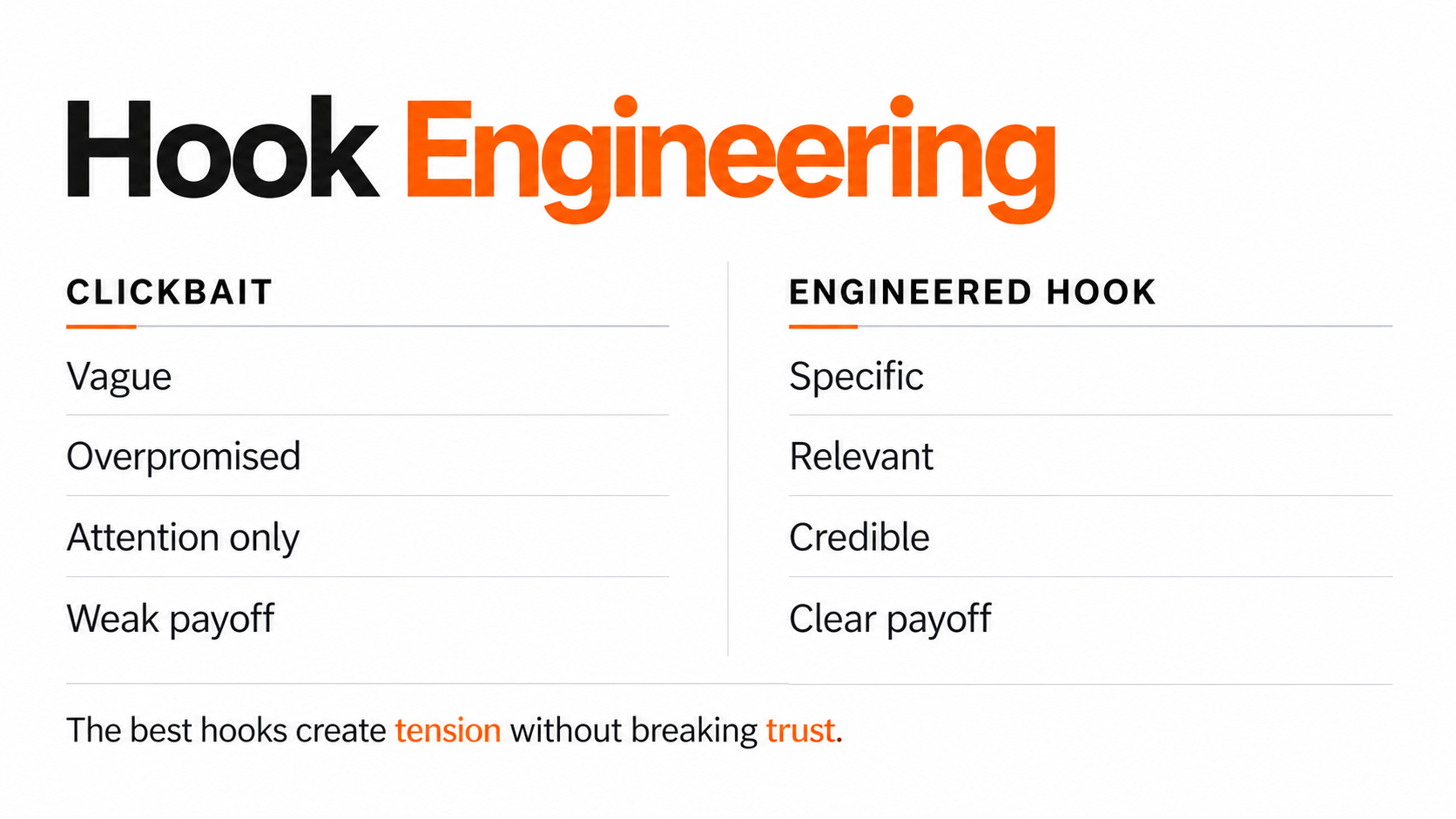
Suggested visual:
A clean side-by-side graphic comparing “Clickbait” and “Engineered Hook.”
Left:
Vague
Overpromised
Attention only
Weak payoff
Right:
Specific
Relevant
Credible
Clear payoff
Caption:
The best hooks create tension without breaking trust.
1. Curiosity: create a gap worth closing
Curiosity becomes useful when people understand enough about the subject to realize that something is missing.
Research on curiosity often describes this as an information gap: the difference between what someone knows and what they want to know.
That has an important implication for content.
Mystery alone is not enough.
If the audience has no context, there is nothing meaningful to be curious about.
Compare:
Weak:
“You need to see this.”
See what?
Why?
Who is it for?
There is almost no useful information.
Better:
“Most content calendars answer what to post. They never answer what each post is supposed to achieve.”
Now the reader already understands the subject.
But a gap remains:
What should each post achieve?
That gap creates a reason to continue.
Better curiosity usually gives before it withholds
Try this structure:
Known situation + missing explanation
Examples:
“Your reach increased, but your inbound leads did not. Here is the part most analytics dashboards cannot explain.”
“You can have a strong personal brand and still make your expertise difficult to buy.”
“Most creators know their audience demographics. Far fewer understand the decision that audience is trying to make.”
The reader is not being teased with nothing.
They are being given enough information to identify a useful unknown.
That is a much stronger form of curiosity.
2. Specificity: make the hook feel real
Generic hooks create generic attention.
Specific hooks give the brain something concrete to process.
Compare:
Generic:
“How to improve your content.”
Specific:
“Before writing your next LinkedIn post, answer these three questions: who is it for, what should they understand, and what should happen next?”
Specificity can come from:
- A clear audience
- A defined problem
- A particular situation
- A number, when the number is real and useful
- A timeframe, when the timeframe actually matters
- A recognizable behavior
- A concrete outcome
- A specific object or process
But numbers are not automatically specific.
“7 secrets that will explode your engagement” contains a number, but the idea is still vague and exaggerated.
Specificity should reduce uncertainty about the subject.
It should not manufacture credibility.
Specificity test
Ask:
Could the audience picture the situation I am describing?
If not, make it more concrete.
3. Contrast: put two ideas in tension
Contrast is one of the simplest ways to make familiar information feel worth reconsidering.
It creates tension between:
- What people do and what works better
- What something looks like and what it actually is
- Attention and trust
- Activity and progress
- Views and business outcomes
- Content calendars and content systems
- More content and better positioning
For example:
“Posting consistently is an activity. Building consistent demand is a strategy.”
Or:
“Attention can make someone notice you. Trust gives them a reason to choose you.”
Neither sentence needs hype.
The tension comes from the comparison.
Contrast works best when both sides matter
Avoid being contrarian just to sound different.
“This popular advice is completely wrong” is not valuable unless you can explain why.
A useful contrast clarifies a decision.
A fake contrast creates an argument.
4. Pattern interruption: break the expected rhythm
People become familiar with repeated formats.
They have seen:
“Here are five tips…”
“Stop scrolling…”
“You need to hear this…”
“POV…”
“Three secrets nobody tells you…”
After enough repetition, the pattern itself becomes easy to ignore.
Pattern interruption means presenting something that does not immediately match the audience's expected sequence.
Research on visual attention suggests that novel or surprising features can compete strongly for attention. In content, the practical lesson is simple: something noticeably different from the surrounding pattern may earn another look.
That difference does not have to be loud.
It can be unusually simple.
For example, imagine a feed full of highly designed graphics.
A plain white image containing one line may become the pattern interrupt.
Or imagine every creator in a niche saying:
“Post more.”
Your opening could be:
“You probably do not need another post this week.”
Now there is tension.
The important part comes next.
You need to explain why.
Pattern interruption earns attention.
Explanation earns trust.
5. Problem recognition: make people feel understood
Some of the strongest hooks do not teach anything new in the first line.
They accurately describe something the audience already experiences.
For example:
“You keep saving content ideas, but when it is time to post, none of them feel worth publishing.”
The reader may immediately think:
That is exactly what happens.
Problem recognition works because relevance becomes obvious.
You are not asking the audience to figure out whether the content matters to them.
You are showing them.
Go deeper than surface pain
Weak:
“Struggling with social media?”
Almost everyone in the market has seen that sentence.
Better:
“You are posting consistently, but every week still starts with the same question: what should we publish?”
Better again:
“You have a content calendar. The real problem is that none of the posts have a defined job after they are published.”
The deeper you understand the situation, the less hype you need.
6. Outcome: show people why continuing is worth it
Sometimes the strongest hook is not mystery.
It is clarity.
People want to know what they will gain by continuing.
Examples:
“By the end of this guide, you will have a repeatable process for writing hooks without relying on clickbait templates.”
“Here is how to turn one broad content idea into five angles for five different buyer problems.”
“Use this checklist before publishing your next carousel.”
Outcome-based hooks work particularly well when the audience already knows what they want.
But the outcome must remain believable.
Avoid:
“This one sentence will make every post go viral.”
No hook can guarantee that.
Use:
“This framework can help you make your opening more specific, relevant, and easier to continue reading.”
One promises an impossible result.
The other promises a practical improvement.
7. Visual hooks: attention starts before the caption
On visual platforms, people can react to the image before consciously reading the copy.
That means your hook may begin with:
- The subject of the first frame
- A facial expression
- An object
- Movement
- A screenshot
- A comparison
- A before-and-after
- A large number
- A short headline
- Negative space
- An unexpected crop
- A visible result
The best visual hook usually supports the content rather than decorating it.
If your post is about simplifying a content system, showing a complicated dashboard next to a simple workflow may communicate the idea faster than an unrelated stock photo.
Visual hook rule
Ask:
If someone saw the first frame without hearing the audio or reading the caption, would they understand what kind of idea is coming?
They do not need the full answer.
They need enough context to decide whether to stay.
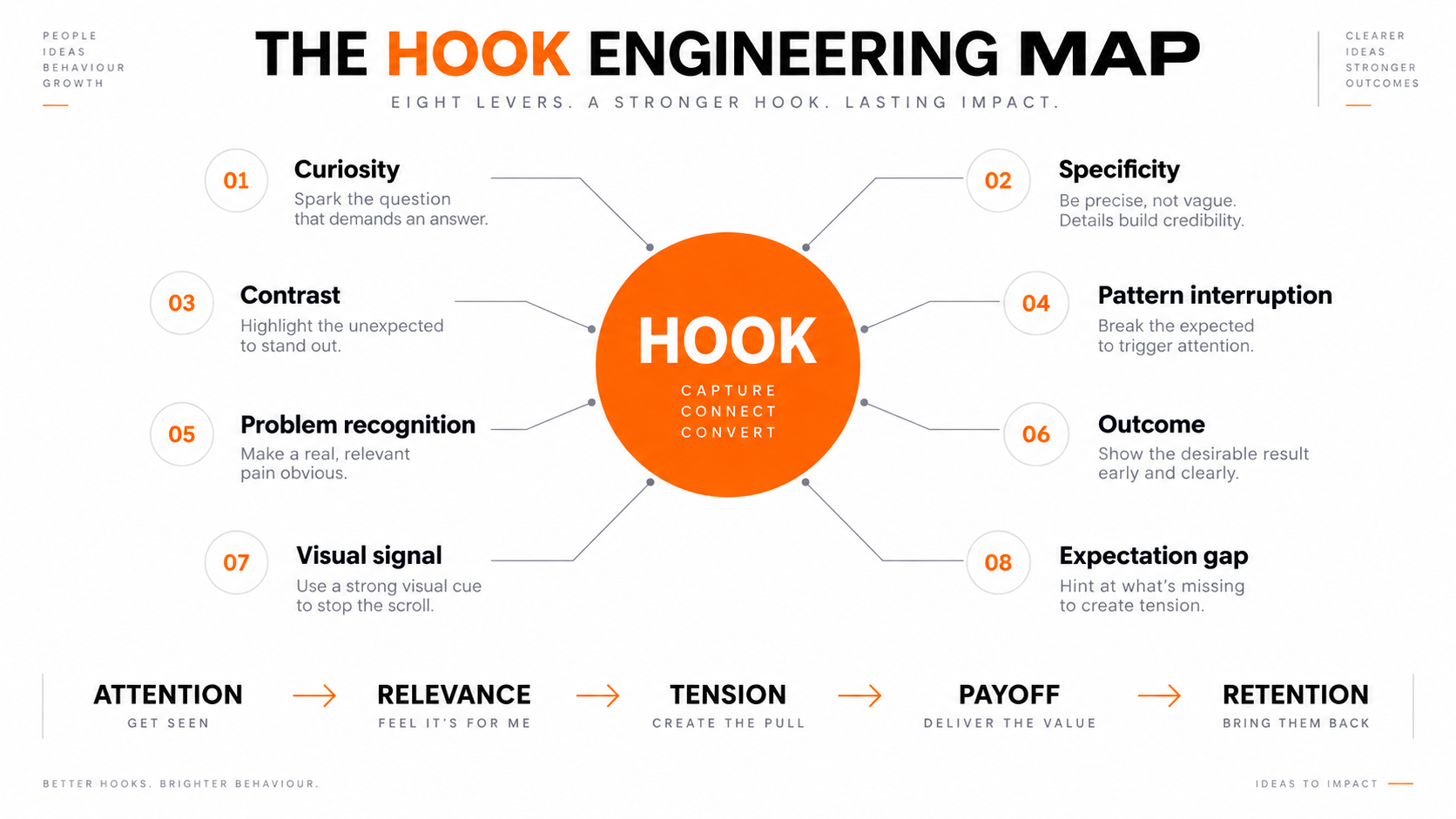
Suggested visual:
A premium infographic with “HOOK” in the center.
Around it:
Curiosity
Specificity
Contrast
Pattern interruption
Problem recognition
Outcome
Visual signal
Expectation gap
Below:
Attention → Relevance → Tension → Payoff → Retention
Caption:
A strong hook is usually a combination of mechanisms, not a single template.
8. The opening sentence: remove the runway
Many openings take too long to reach the idea.
Example:
“In today's fast-paced digital world, social media has become more competitive than ever before.”
The sentence sounds reasonable.
It also says almost nothing.
The reader already knows social media is competitive.
Start closer to the useful part.
Instead:
“Most hooks do not fail because they are badly written. They fail because the audience cannot quickly see why the next sentence matters.”
Now the article has somewhere to go.
Delete introductions that only announce the topic
Avoid:
“Today I am going to share…”
“In this article we will discuss…”
“As we all know…”
“Social media is constantly evolving…”
You can usually remove these sentences without losing anything.
Start where the tension starts.
9. Expectation gap: challenge the obvious answer
An expectation gap appears when the audience predicts one explanation, but you introduce another plausible one.
This is a practical content concept rather than a magic psychological formula.
Example:
Audience expectation:
Low engagement means the content needs a better hook.
Alternative:
The hook may be fine. The topic may simply be irrelevant to the audience you attracted.
Hook:
“Your hook might not be the reason people stop reading.”
Now the reader wants to understand the alternative explanation.
Another example:
“You do not always need a stronger CTA. Sometimes you need a clearer reason to care before the CTA arrives.”
The goal is not to say the opposite of everyone else.
The goal is to reveal a useful distinction.
Expectation gaps need evidence
If you challenge a common belief, explain the mechanism.
Do not write:
“Everything you know about marketing is wrong.”
Write:
“More reach does not automatically create more demand because reach and buying intent measure different things.”
Now the contrast can be explained.
10. Retention after the hook: where most hooks actually fail
The opening earned attention.
Now you have to keep it.
YouTube's own creator guidance separates appeal, engagement, and satisfaction. It also advises creators to make sure the opening delivers on the expectation created by the title and thumbnail, then maintain interest through the content.
That principle travels well beyond YouTube.
The hook is a promise.
Retention depends on how quickly and consistently you start paying it back.
Use the Hook → Bridge → Evidence → Payoff structure
Hook
Create the reason to continue.
Example:
“Your content calendar may be solving the wrong problem.”
Bridge
Explain why the statement matters.
“Most calendars organize publishing dates. They do not tell you what business job each piece of content should perform.”
Evidence or explanation
Develop the idea.
“One post might attract a problem-aware audience. Another can build trust. Another can handle an objection. Another can create a reason to start a conversation.”
Payoff
Resolve the original tension.
“If every post only has the job of ‘getting engagement,’ you have a posting schedule, not a complete content system.”
Next action
Give the audience somewhere useful to go.
“Before planning the next month, assign one strategic job to every piece of content.”
That sequence keeps the hook connected to the actual value.
The hook-retention mismatch
Imagine this opening:
“The biggest mistake destroying your personal brand…”
Then the content says:
“Be consistent.”
The hook created more tension than the answer could justify.
That is a hook-retention mismatch.
The audience may have stopped.
But the content weakened trust.
Now imagine:
“You do not have to post every day to build a recognizable personal brand. You need repeated ideas people can associate with you.”
Then the content explains:
- Consistent positioning
- Repeated expertise
- Recognizable point of view
- Repeatable content themes
- Proof
- Distribution
The hook and payoff belong together.
That is what you want.
A practical hook engineering workflow
Do not wait for the perfect first sentence to appear.
Engineer it.
Step 1: Start with the audience situation
What is happening in their world?
Not:
“Social media growth.”
Instead:
“A founder posts three times a week but still cannot tell which content creates qualified conversations.”
Now you have something specific to write from.
Step 2: Define the useful truth
What does the content actually prove, explain, or help someone do?
Example:
“Publishing frequency cannot fix unclear content roles.”
Step 3: Find the tension
What is the difference between the current belief and the useful truth?
Current belief:
“We need to publish more.”
Useful truth:
“We need each post to have a clearer strategic job.”
Step 4: Choose the hook mechanism
You could use:
Contrast:
“More content will not fix a content system with no direction.”
Problem recognition:
“You are publishing every week, but every post is trying to do the same job.”
Curiosity:
“The problem with your content calendar may have nothing to do with the calendar.”
Outcome:
“Give every post one job and your monthly content plan becomes much easier to evaluate.”
Specificity:
“Before approving a post, answer one question: what should this content make the right buyer think, feel, understand, or do?”
Same underlying idea.
Different hook.
Step 5: Write the second line before choosing the first
This is one of the easiest ways to reduce clickbait.
If you cannot write a strong second sentence, your first sentence may be creating tension you cannot support.
Step 6: Check the payoff
Read the hook.
Then read the conclusion.
Did you answer the question you created?
If not, fix one of them.
20 hook templates that do not depend on clickbait
These are frameworks, not sentences to copy blindly.
Problem recognition
- “If your [metric] looks healthy but [business outcome] is weak, check [deeper issue].”
- “You are doing [common action], but you are still dealing with [specific problem].”
- “[Problem] usually becomes visible after [specific situation].”
Contrast
- “[Common action] is not the same as [desired outcome].”
- “You do not need more [common solution]. You need clearer [mechanism].”
- “Most people optimize [surface metric]. The harder problem is [deeper outcome].”
- “[Thing A] creates [result A]. [Thing B] creates [result B].”
Curiosity
- “There is one part of [familiar process] most people never define.”
- “The problem may start earlier than you think.”
- “You can do [positive action] correctly and still get [negative result].”
Specificity
- “Before you [action], answer these three questions.”
- “If [specific event] happens, check [specific factor] before changing everything.”
- “A good [asset/process] should answer one question: [question].”
Expectation gap
- “Your [obvious problem] might not be a [expected cause] problem.”
- “The strongest part of your [asset] may be creating the wrong expectation.”
- “The advice sounds right until you measure [downstream result].”
Outcome
- “Use this process to turn [starting point] into [practical result].”
- “Here is a simpler way to decide [specific decision].”
- “By the end of this, you should know exactly how to [specific action].”
Direct insight
- “The easiest way to improve [thing] is to stop asking [weak question] and start asking [better question].”
The words should change.
The mechanism can stay.
Examples: weak hook vs. engineered hook
Social media strategy
Weak:
“Want better social media results?”
Better:
“If your posts get engagement but rarely create qualified conversations, audit what happens between attention and the CTA.”
Personal branding
Weak:
“Build a powerful personal brand.”
Better:
“If people remember your posts but cannot explain what they should hire you for, your personal brand has an association problem.”
Content creation
Weak:
“Here are five content tips.”
Better:
“If every post starts from ‘What should I post today?’, your content process is already costing you more time than it should.”
SaaS
Weak:
“Improve your onboarding.”
Better:
“Your onboarding may not be too long. It may be asking users to invest effort before they experience enough value.”
Ecommerce
Weak:
“Get more conversions.”
Better:
“If shoppers reach your product page but hesitate, check whether the page answers the risk questions before adding more urgency.”
Notice what changed.
The better examples do not necessarily sound more dramatic.
They sound more relevant.
How storytelling improves a hook
A story creates movement.
Something was true.
Something changed.
Something was discovered.
Something now needs to be resolved.
You do not need a dramatic life story.
A small moment can create enough narrative tension.
For example:
“Imagine spending an hour writing a post, watching it get thousands of views, and realizing you still cannot explain what those views did for the business.”
Now there is a situation.
Then move into the insight:
“That is why I separate attention metrics from business intent. A post can be successful at distribution and weak at conversion at the same time.”
The story opens the door.
The insight gives the story a reason to exist.
Edutainment without turning useful content into entertainment bait
Edutainment works when learning becomes easier to consume.
It does not mean every idea needs jokes, drama, exaggerated editing, or trending audio.
You can make educational content more engaging through:
- Analogy
- Contrast
- Story
- Visual explanation
- Examples
- Before-and-after
- Demonstration
- Breakdown
- A surprising but defensible observation
For example:
“A hook is like a door.
Its job is not to be the entire house.
It only needs to make the right person want to enter.
If the room behind the door is empty, a better door does not solve the problem.”
That analogy teaches the relationship between hook and payoff without reducing the topic to a generic tip.
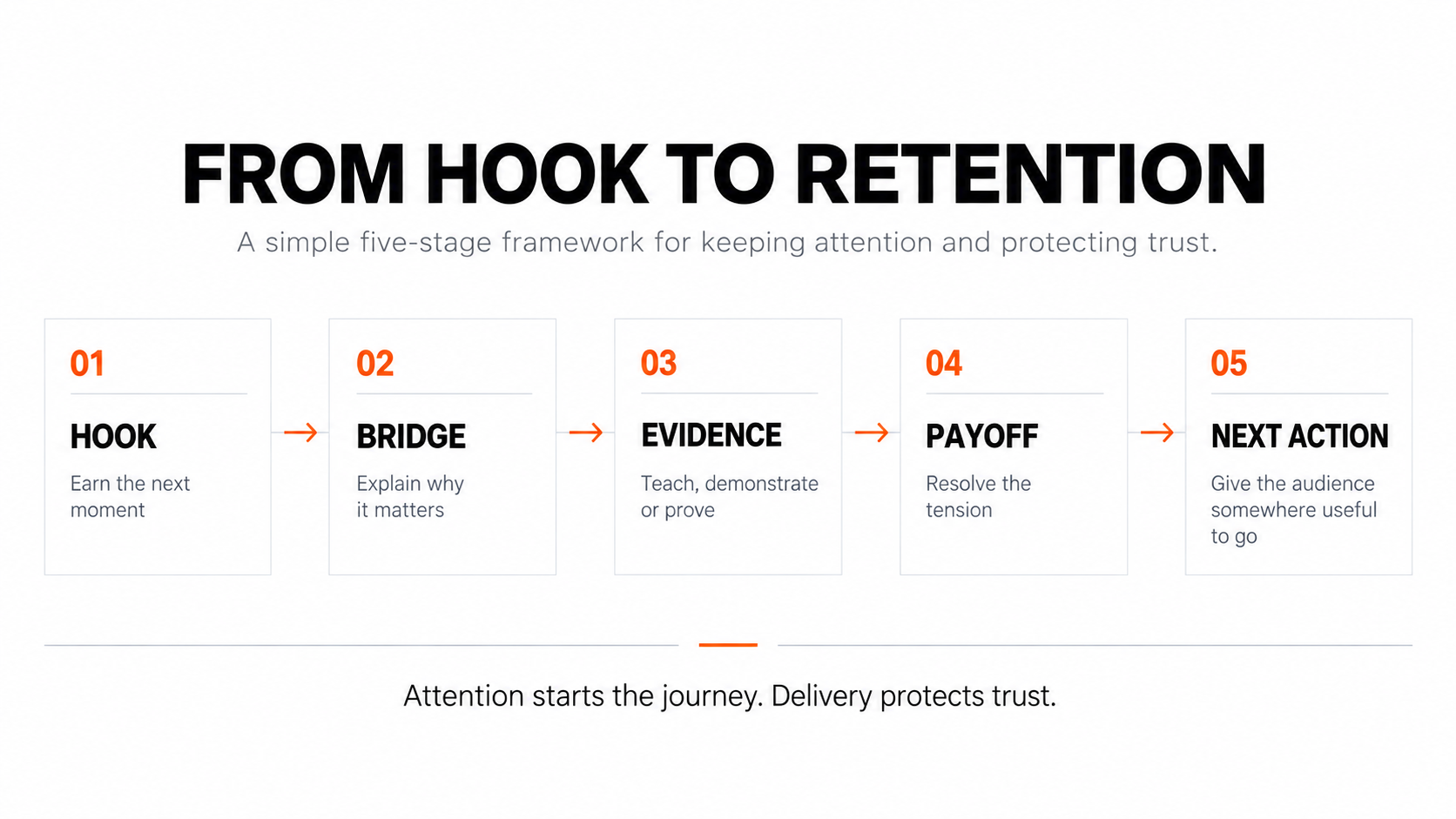
Suggested visual:
A horizontal content flow:
HOOK
Earn the next moment
↓
BRIDGE
Explain why it matters
↓
EVIDENCE
Teach, demonstrate, or prove
↓
PAYOFF
Resolve the tension
↓
NEXT ACTION
Give the audience somewhere useful to go
Small footer:
Attention starts the journey. Delivery protects trust.
How to audit a hook before publishing
Ask these questions.
1. Who is this clearly for?
Could the right audience recognize themselves?
2. What is specific?
Is there a real situation, problem, outcome, behavior, or distinction?
3. Where is the tension?
What makes someone want the next sentence?
4. Is the claim defensible?
Could you explain or prove it without changing the subject?
5. Does the content deliver?
Does the payoff resolve what the hook opened?
6. Is the wording doing unnecessary work?
Remove filler.
Remove fake urgency.
Remove exaggerated adjectives.
Remove empty mystery.
7. Does the visual support the message?
For visual content, the first frame should strengthen rather than compete with the opening idea.
8. Would the hook still work without hype?
Replace:
“shocking”
“insane”
“secret”
“guaranteed”
“everyone”
“never”
“game-changing”
with the real idea.
If the hook collapses after removing hype, the underlying idea probably needs more work.
How to measure whether your hooks are actually improving
Do not judge hooks only by views.
Different formats give you different signals.
You might look at:
- Whether people choose to open or watch
- Early audience retention
- Reading or viewing continuation
- Saves
- Shares
- Replies
- Comments that show understanding
- Profile visits
- Qualified conversations
- Leads or conversions when relevant
For video, audience retention is especially useful because it shows where viewers continue, leave, skip, or rewatch.
YouTube's official retention tools, for example, let creators inspect how well the opening holds viewers and where drops or spikes occur.
But do not optimize the first few seconds while ignoring everything after them.
A high-performing hook attached to disappointing content is not a sustainable win.
The real goal is:
Attention → Understanding → Trust → Useful action
Which action matters depends on the content.
Sometimes it is watching another minute.
Sometimes it is saving the post.
Sometimes it is remembering your point of view.
Sometimes it is visiting your work and case studies.
Sometimes it is starting a conversation.
A hook should serve the content objective, not replace it.
The most important hook rule
Do not ask:
“How can I make people stop?”
Ask:
“Why should the right person want to continue?”
The first question can lead you toward tricks.
The second forces you to think about relevance.
That shift changes everything.
Because great hooks are not built from dramatic language.
They are built from audience understanding.
You understand the problem deeply enough to describe it accurately.
You understand the idea clearly enough to create useful tension.
You understand the payoff well enough to make a promise you can keep.
That is hook engineering.
Not manipulating attention.
Earning it.
For more practical breakdowns on content strategy, positioning, social media growth, and building content systems, explore the Insights library.
Frequently asked questions about hook engineering
What is hook engineering?
Hook engineering is the process of intentionally designing the opening of a piece of content to earn attention through relevance, curiosity, specificity, contrast, problem recognition, an outcome, or another meaningful tension. A strong hook also matches the content that follows.
What makes a hook effective?
An effective hook quickly communicates relevance and creates a reason to continue. Strong hooks often combine a clear audience or problem with specificity, curiosity, contrast, or a useful outcome. The content must then deliver on the expectation.
Is a curiosity gap the same as clickbait?
No. A curiosity gap simply gives someone a reason to seek missing information. It becomes clickbait when the opening exaggerates, misleads, hides essential context, or promises a payoff the content does not adequately provide.
How long should a hook be?
There is no universal ideal length. A hook should be as short as possible while still creating enough context and value to make the next part worth consuming. The right length depends on the platform, format, audience, and idea.
What is a visual hook?
A visual hook is the first visual signal that attracts or directs attention. It can be a person, object, movement, comparison, screenshot, headline, transformation, unusual composition, or another relevant visual element.
What is pattern interruption in content?
Pattern interruption is a practical creative technique that breaks from what the audience expects to see or hear. It may use a different visual, sentence structure, viewpoint, format, or opening. The interruption should remain relevant to the content rather than exist only for shock.
How do I improve retention after the hook?
Start delivering immediately. Explain why the hook matters, develop the idea with evidence or examples, and resolve the tension that the opening created. Avoid long introductions or changing the subject after earning attention.
Should I use numbers in hooks?
Use numbers when they add genuine specificity or structure. Do not invent statistics, use unsupported percentages, or add numbers simply because they look persuasive.
Can the same hook work on LinkedIn, Instagram, TikTok, YouTube, and blogs?
The underlying idea can travel, but the packaging should change. A LinkedIn hook may rely on the opening sentence, while short-form video can combine visuals, spoken words, movement, and on-screen text. YouTube may depend heavily on the relationship between title, thumbnail, and opening. Blog content also depends on its headline and introduction.
What is the best hook formula?
There is no single formula that works for every audience or topic. A stronger approach is to understand the audience situation, define the useful idea, identify the tension, choose the appropriate hook mechanism, and make sure the content delivers the promised payoff.
Final takeaway
The future of hooks will not belong to whoever can create the loudest opening.
As audiences see more content and become familiar with more templates, generic attention tricks become easier to recognize.
The durable advantage is deeper audience understanding.
Know what your audience is trying to solve.
Know what they expect.
Know what they are missing.
Know what outcome matters.
Then use curiosity, specificity, contrast, pattern interruption, problem recognition, visuals, and expectation gaps to present that value clearly.
Make people stop because the idea matters.
Then give them a reason to stay.