Building Social Media Systems That Turn Attention Into Growth
A strategy-first social media portfolio showing how audience psychology, stronger hooks, content systems, and disciplined execution produced measurable organic growth across multiple platforms.
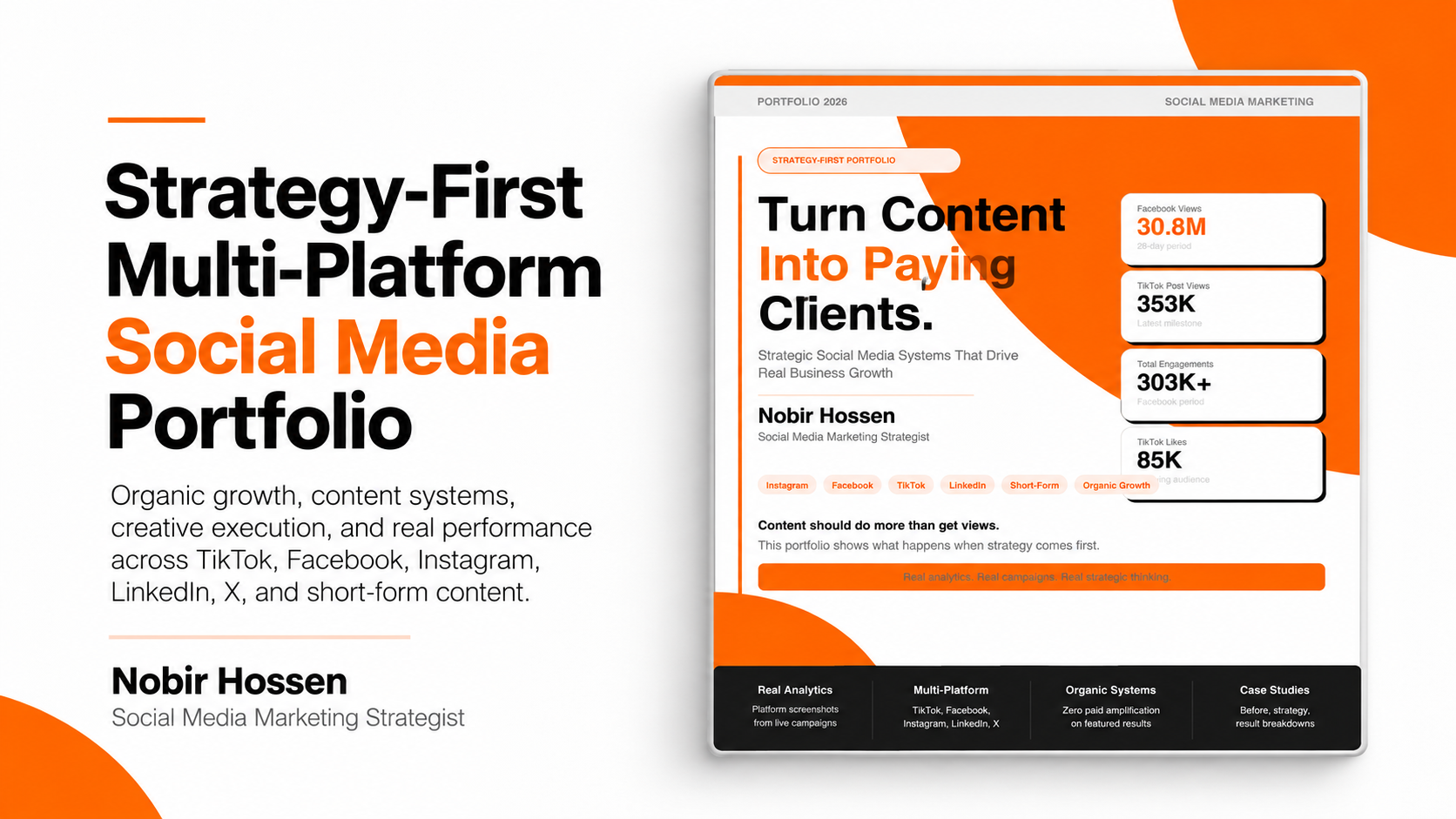
I did not build this portfolio around one platform or one viral result.
I built it around a question I kept coming back to:
Why does some content create momentum while other content disappears, even when the business is posting consistently?
The more accounts and platforms I worked with, the clearer the answer became.
Most of the time, the problem is not simply the content.
It is the system behind it.
The audience is not clear enough. The positioning changes too often. The hook does not earn attention. The content has no role inside a larger journey. Or performance is measured by views without asking what those views are actually doing for the business.
That changed the way I started approaching social media.
Instead of thinking post by post, I began thinking in systems.
Audience first. Positioning next. Then hooks, content structure, funnel stages, consistency, execution, and performance feedback.
The platform still matters. TikTok needs a different opening from LinkedIn. Facebook distribution behaves differently from X. Instagram has its own visual and short-form mechanics.
But the deeper principles stay surprisingly consistent.
Earn attention.
Build trust.
Create intent.
Give that intent somewhere to go.
That thinking sits behind the work in this portfolio.
The results include 30.8M Facebook views in a 28-day organic period, a TikTok account that reached a 353K-view milestone, 174.8K impressions on X, 303.6K Facebook engagements, 13.5K net Facebook followers, and 85K TikTok likes.
But the numbers are only part of the story.
The real work was building a system capable of producing better signals, learning from audience behavior, and turning those signals into the next decision.
The challenge was not simply to create more content.
It was to build a repeatable social media system that could work across different platforms, audiences, formats, and stages of the customer journey without turning the strategy into random posting.
That meant solving for positioning, attention, retention, consistency, organic distribution, audience behavior, creative quality, and conversion at the same time.
More content does not automatically create more growth.
Without clear positioning, audience understanding, strong hooks, and a reason for each piece of content to exist, posting more often simply creates more noise.
The biggest shift came when I stopped treating content as isolated posts and started treating it as a connected system.
My approach starts before the content is created.
I first study the audience: what they care about, how they speak, what frustrates them, and what makes them pay attention.
Then I clarify the positioning so the brand sends a consistent signal.
From there, I build the hook architecture, map content across awareness, trust, and conversion stages, create a sustainable publishing system, and use performance data to improve what comes next.
The goal is not to make every post look successful.
The goal is to make the entire content system become smarter over time.
Instagram
Reels-first content, carousel structure, brand consistency, and story-led funnel movement.
Facebook
Reach-oriented content, community and share mechanics, longer-form captions, and organic distribution systems.
TikTok
Hook, retention, curiosity gaps, pattern interrupts, and re-watch behavior.
LinkedIn
Thought leadership, authority positioning, story-driven content, and insight-led audience trust.
X / Twitter
Consistent idea distribution, engagement-driven content, and compounding account-level visibility.
Short-Form
Cross-platform content adapted for the mechanics of each channel rather than blindly reposted everywhere.
I think about content as behavior, not just creative output.
A scroll stop is a response.
A share is a response.
A profile visit is a response.
That means hooks, emotional triggers, curiosity gaps, retention, trust, and conversion can all be designed more deliberately.
The goal is not clickbait.
The goal is to create enough relevance, curiosity, or emotion for the right person to feel that continuing is worth their attention.
