Canva Content-to-Conversation System: An Independent Growth Strategy Case Study
An independent strategy case study: how I would turn Canva's social content into real team adoption, from audience research to a 90-day, measurement-backed pilot plan.
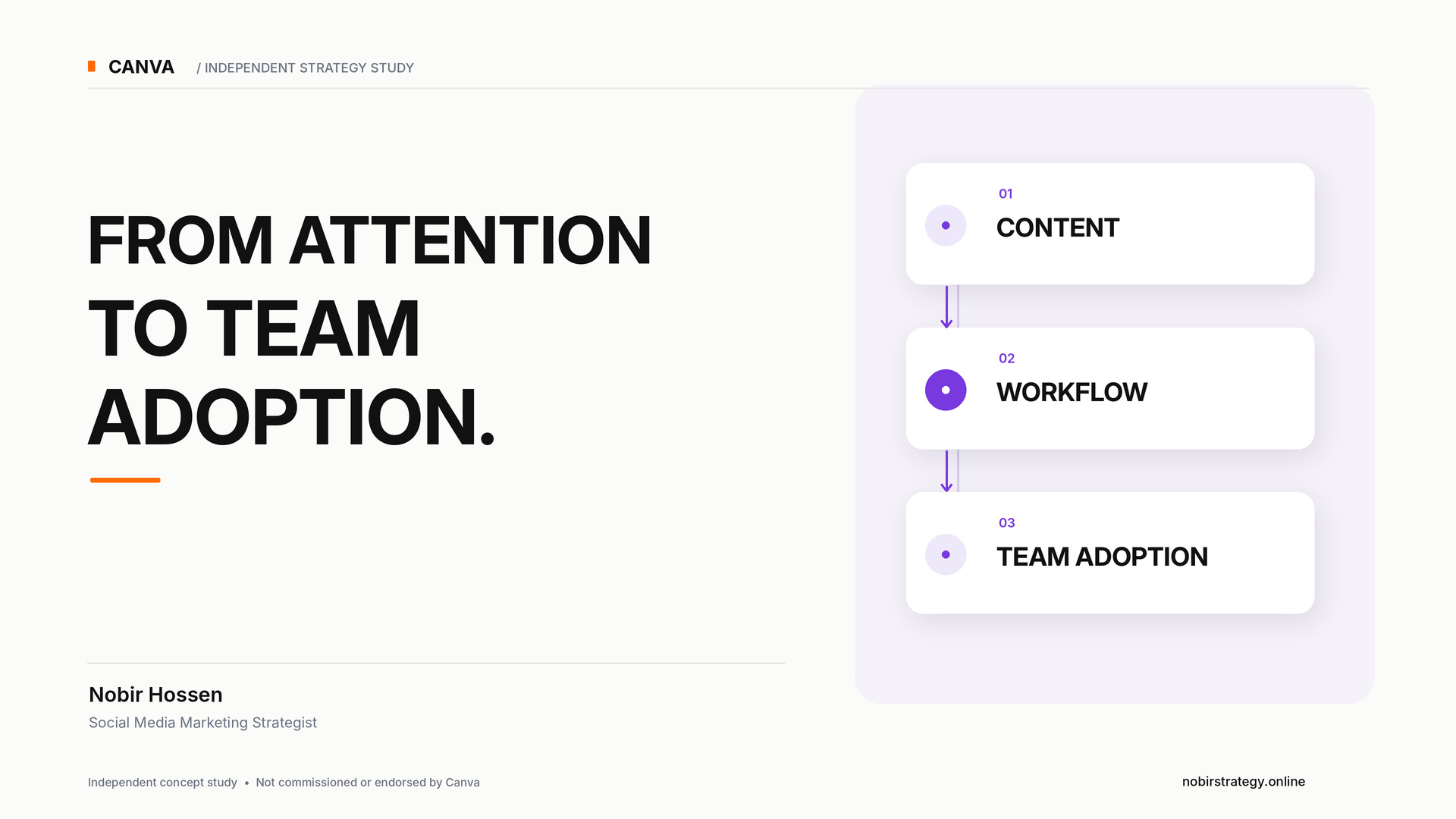
This is an independent strategy case study. I am not working with Canva, and nothing in it was commissioned, endorsed, or implemented by them. I built it to show how I approach a growth problem from the outside, using only public information, research discipline, and strategic judgment, the same way I would open a real client engagement.
Canva's product is expanding fast. In 2026 alone, the company shipped Canva AI 2.0, a broader Visual Suite and ProSuite, and a new image model called Canva Craft. That pace creates a problem most fast-moving product companies share: the audience can recognize a feature without ever seeing the complete workflow it enables. A Canva and Harris Poll survey backs this up. 97% of marketing leaders say they already use AI in daily creative work, but 87% of consumers still say the best advertising needs a human touch. More AI capacity does not automatically build trust. Creative direction becomes the differentiator.
I designed a content-to-conversation system built around two separate paths: a self-serve path for individual users who complete one useful task, and a sales-assisted path for marketing leads who need to justify a team-wide workflow change to their manager. Six channels (LinkedIn, Instagram, TikTok, YouTube, Community, and paid) each get one clear job instead of repeating the same message everywhere. Four editorial series rotate under this system: naming the handoff problem, building the workflow live, explaining the judgment behind it, and giving a champion something they can bring upward. A Docusign customer story already published by Canva, which cut battle card production from 7 days to 1.5, became the proof point that operational change, not a feature list, is what actually moves a team to adopt something new.
From there I built the full system end to end: a positioning statement, a LinkedIn carousel concept, a Reel and TikTok storyboard, a YouTube tutorial outline, a non-functional landing page concept, a measurement framework with five tracked events, and a 90-day pilot plan with three decision gates. Every claim is sourced, and every projection is labeled as a hypothesis rather than a result.
Because this was never executed, there are no campaign results to report here, and I am not claiming any. What it shows instead is how I think through a growth problem end to end: research first, honest about what is proven versus assumed, and structured so a real team could run it as a 90-day pilot without having to rebuild it from scratch.
Challenge
Canva's product is expanding faster than its story can stay simple. People can recognize one feature without ever seeing the complete workflow it's part of, and that gap is what stops a single user's enthusiasm from becoming a team habit.
Approach
Built a two-path content-to-conversation system: self-serve for individual task completion, sales-assisted for team-wide adoption. Assigned each of six channels one clear job, then built four rotating editorial series to carry the story from problem to team buy-in, backed by one real, already-published customer proof point.
Deliverables
• Audience and buyer group map • Positioning statement and competitive framing • Six-channel content strategy • Four-series editorial engine • LinkedIn carousel concept • Reel and TikTok storyboard • YouTube tutorial concept • Landing page concept • KPI tree and event tracking specification • 90-day pilot roadmap with decision gates • Risk and guardrail framework
Results
This is an independent, unexecuted strategy study. No client results, revenue, or performance numbers are claimed anywhere in it. What it demonstrates is the complete thinking process, from research through to a pilot a real team could run, built entirely from public information.
Evidence
Built from 15 public sources, including Canva Newsroom announcements, a Canva / Harris Poll survey (1,415 marketing leaders, 3,547 consumers), and one Docusign customer case study already published by Canva. Every source is cited and dated. No internal Canva data, analytics, or client interviews were used.
