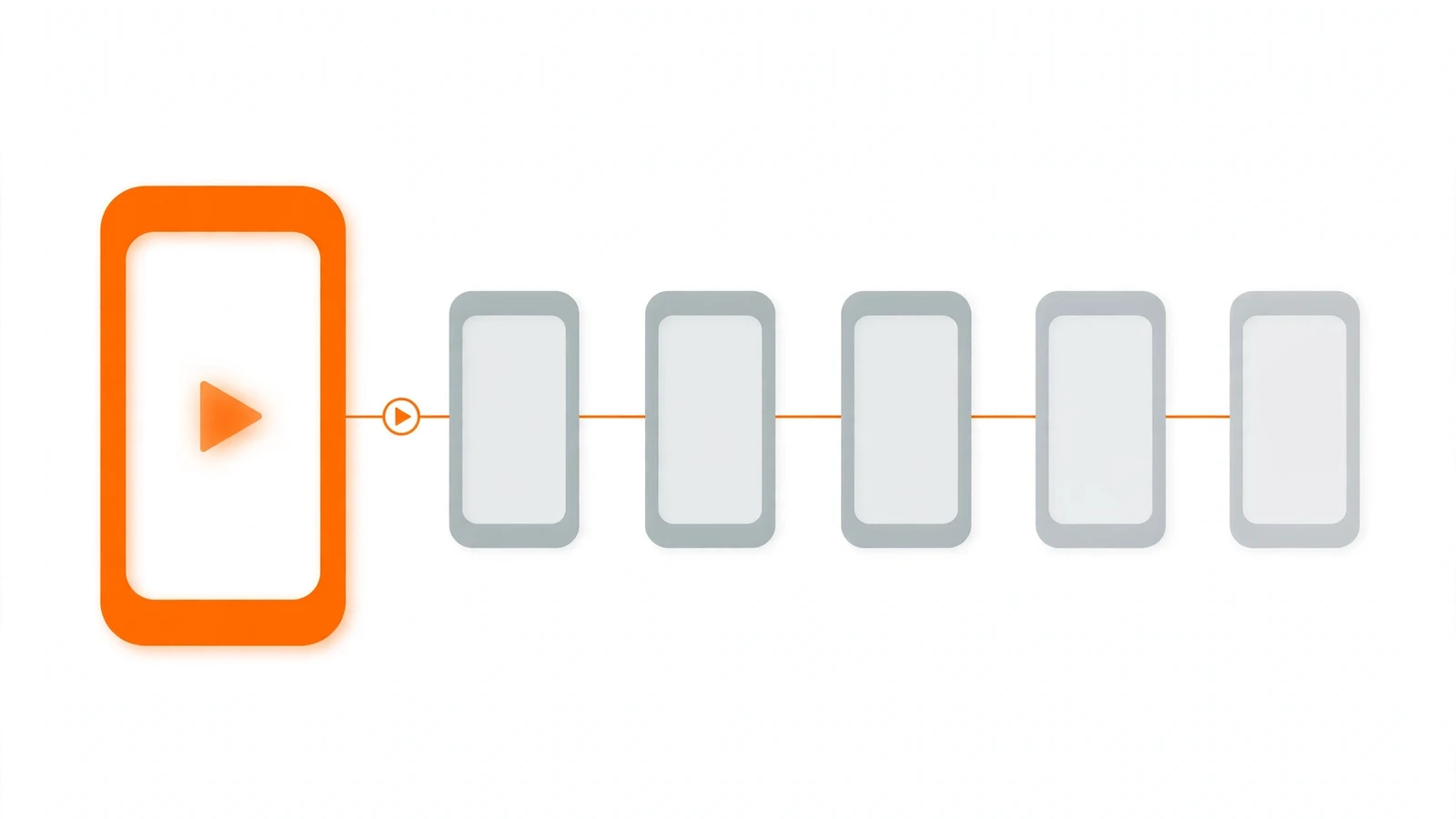
Most service businesses post Shorts the way they post tips: one useful clip here, another one next week, no order, no thread between them. A stranger who likes one clip has nowhere obvious to go next. YouTube Shorts series fixes the order problem. It groups Shorts into seasons and episodes, with a watch series button that plays them in sequence. The question is not whether you can make a series. It is whether the series earns the next step, from a first episode to a real conversation.
YouTube launched Shorts series on 23 September 2026, as part of its Made on YouTube announcements, and said it was rolling out to creators across web, mobile, and TV. On 27 October 2026, YouTube returned to the format in a blog post about microdramas, the short serialized dramas told in fast scenes on Shorts. That post said microdramas had passed 6.5 billion views in the first half of 2026, with watch time growing by more than 50 percent year over year. It also said 40 percent of microdrama views and 30 percent of clicks arrived more than 30 days after a video went live. Those are YouTube platform figures about dramas, not a promise about your videos. They still make one point worth noting: an episode can keep finding viewers long after its first week, if a viewer can find the next one.
How does a YouTube Shorts series actually work?
A Shorts series is a show built from Shorts. You create it in YouTube Studio on a computer, under Create, then New show, or you add show features to a playlist that contains only Shorts. Each episode must be portrait or square and no longer than 180 seconds, the same three minute limit as any Short. You set a season number, and you choose serial, where episodes play in order from oldest to newest, or non-serial, where order does not matter. Each episode can have its own custom thumbnail. A viewer who meets an episode in the Shorts feed sees a watch series button, which opens a feed where episodes play in sequence. The series also appears as one entry on your channel, rather than filling your Shorts grid, and it shows in the Shows tab.
One detail is still unsettled, so check it in your own Studio before you plan around it. Some reporting says the rollout starts with creators in the YouTube Partner Program. YouTube's own help page does not list an eligibility requirement. If you do not see Create, then New show, the rollout may not have reached your channel yet. That is a reason to plan the season now and publish it when the option appears, not a reason to rebuild your whole channel around a button you cannot see.
Why would a series work better than scattered Shorts for a service business?
A scattered Short has one job: earn attention in a feed. A series has a second job: carry attention forward. A buyer rarely hires a coach after one tip. They hire after they have seen the thinking hold up across a few steps. A series gives that thinking a shape. Episode one names a problem the buyer already feels. The middle episodes work through it in order. The last episode points to one clear next step. Without that shape, each clip has to do all the work alone, and most clips cannot.
This is different from the search job of a Short. A searchable Short answers a question someone already typed, as explained in Your Next Client May Search, Not Scroll: How Short Videos Get Found. A series answers the question that comes after the first answer. The first clip gets found. The series keeps the viewer. Both matter, but they are not the same job, and a channel that only chases the first job will keep meeting strangers for the first time.
What should one season cover?
One season should cover one buyer problem, in steps, not one topic in general. "Content tips" is not a season. "Why your posts get likes but no inquiries, and what to fix first" is a season, because it has an order. A coach who helps new managers could build a season around the first month in a new role: episode one on the first team meeting, episode two on the first hard conversation, episode three on the first decision that sets a pattern. A consultant who helps service businesses price their work could build a season around one pricing mistake per episode, each one ending with the question the next episode answers.
Keep the season short enough to finish. Five or six episodes is a good first season. Fewer than that, and the series barely has a shape. Many more, and you risk a season you never complete, which teaches a viewer that your series does not end. A finished short season beats a long unfinished one, because a viewer can reach the last episode and the next step.
How do you plan episodes that each stand alone?
Every episode needs two qualities at once. It must make sense on its own, because most viewers will meet it alone in the feed. And it must be better watched in order, because that is the whole point of a series. The practical test is simple: if someone watches only episode three, do they still learn one complete thing? If the answer is no, the episode is a fragment, not an episode.
Give each episode one job. Episode one should hook a stranger with the sharpest point in the whole season, not with an introduction. The middle episodes should each deliver one idea completely, in plain words, with one concrete example. Every episode except the last should end on the next question, so the watch series button has a reason to be tapped. The last episode should not end on another question. It should end on one next step, such as a conversation, a call, or a useful resource, and that step should be named in words, not only in a link.
A simple outline for a six episode season looks like this:
- Name the problem in the buyer's own words, and show why the usual fix fails.
- Show the first decision that changes the outcome.
- Work through the most common mistake, with one real example.
- Answer the objection you hear most often.
- Show what good looks like, in one short case from your own work, told plainly.
- Summarise the steps, and name the one next step for someone who recognises their own situation.
What should you check before you publish the series?
Check four things in Studio before the first episode goes out. First, the playlist contains only Shorts, since a long video mixed in breaks the series format. Second, the show type is serial if the episodes must be watched in order; a converted playlist defaults to non-serial, so check that setting rather than assuming it. Third, episode numbers follow the order you intend, by publish date or by the manual order you set. Fourth, each episode has its own thumbnail, and the thumbnails look like a set: same layout, same series name, only the image and episode number changing. A viewer scanning a feed should recognise the next episode at a glance.
Also check the thing most service businesses skip: the next step at the end of the last episode must actually work. If the last episode points to a booking page, open that page yourself. If it points to a conversation, say where that conversation happens and what the viewer should mention. A series that carries a viewer to a dead end wastes the trust the earlier episodes built. That final check matters more than the artwork.
What should you measure in the first four weeks?
Do not judge a series by total views alone. A series can gather views while losing viewers between episodes, and that loss is the signal that matters. For four weeks, track five numbers from your own channel, and compare episodes against each other rather than against anyone else's channel:
- How many viewers reach episode two after watching episode one.
- Where the biggest drop between two episodes happens.
- How many saves each episode earns, since a save means someone plans to return.
- How many profile visits and specific questions follow the series, not just likes.
- How many booked calls mention the series, or the problem it covers.
If the drop sits between episode one and two, the first episode promised something the second did not deliver, or the second episode assumed knowledge the viewer did not have. If viewers finish the season but no one takes the next step, the last episode's step is unclear, too big, or missing. Change one thing at a time, and give the change a full week before you judge it. A series is a system, and systems are fixed one link at a time.
What are the three mistakes that waste a good series?
The first mistake is dumping old tips into a playlist and calling it a series. A playlist groups videos. A series tells something in order. If the episodes could be watched in any order with no loss, you have a playlist, and that is fine, but do not expect it to carry a viewer anywhere.
The second mistake is copying the drama format instead of borrowing its structure. Microdramas work because each scene ends with a reason to watch the next one. A service business does not need cliffhangers, acted scenes, or daily episodes. It needs the same discipline in a quieter form: each episode complete, each ending pointing forward, each step building on the last. Borrowing the structure is smart. Pretending to be a drama channel is not.
The third mistake is ending the season without a next step, or ending it with five next steps. A viewer who finishes six episodes has already given you more attention than a feed viewer ever will. Asking for one clear thing respects that attention. Asking for five things spends it. Pick the step that fits the problem the season solved, name it plainly, and let the viewer decide. The series did its job when the viewer arrives at that decision already understanding what you do.
YouTube gave Shorts a shape for stories that run in parts. A service business can use that shape without becoming an entertainment channel. Pick one buyer problem, plan five or six episodes that each stand alone and still belong together, publish them in order, and check where viewers drop off and where they ask a real question. Then fix one link, and run the next season a little better. If you want help turning one talk or one long video into a season that leads somewhere, look at the Social Media Strategy service page and start a conversation from there.
Sources and further reading
- NetInfluencer report on the YouTube Shorts series launch and microdrama figures
- Exemplary guide to setting up a YouTube Shorts series in YouTube Studio
- Your Next Client May Search, Not Scroll: How Short Videos Get Found
- Your Buyer Can Now Tell the Feed What to Show: What That Means for a Service Business
- From Comment to Call: How Service Businesses Turn Instagram Conversations Into Booked Calls
- Your Followers Are Not Your Audience: How to Turn Social Attention Into a List You Can Reach
- Getting Views But No Clients? How to Build a Content-to-Client System for Service Businesses
- Social Media Strategy service page