The AI Content Workflow I Would Build for a Founder in 2026
If a founder asked me to build an AI content system today, I would not start by giving them a list of 25 tools.
That is the easy article to write.
It is also becoming the least useful one.
The problem is no longer access to AI.
Founders already have ChatGPT. They have Claude. They have Gemini. They have Canva. They have automation platforms capable of moving information between almost every part of their business.
The harder question is:
What should each tool actually be responsible for, and where should the human still make the decision?
Because a content system can become faster while simultaneously becoming worse.
It can generate more posts while producing fewer original ideas.
It can make the founder look active while making the founder sound like everyone else.
It can automate publishing while quietly automating trust out of the brand.
That is not the content system I would build.
The system I would build looks like this:
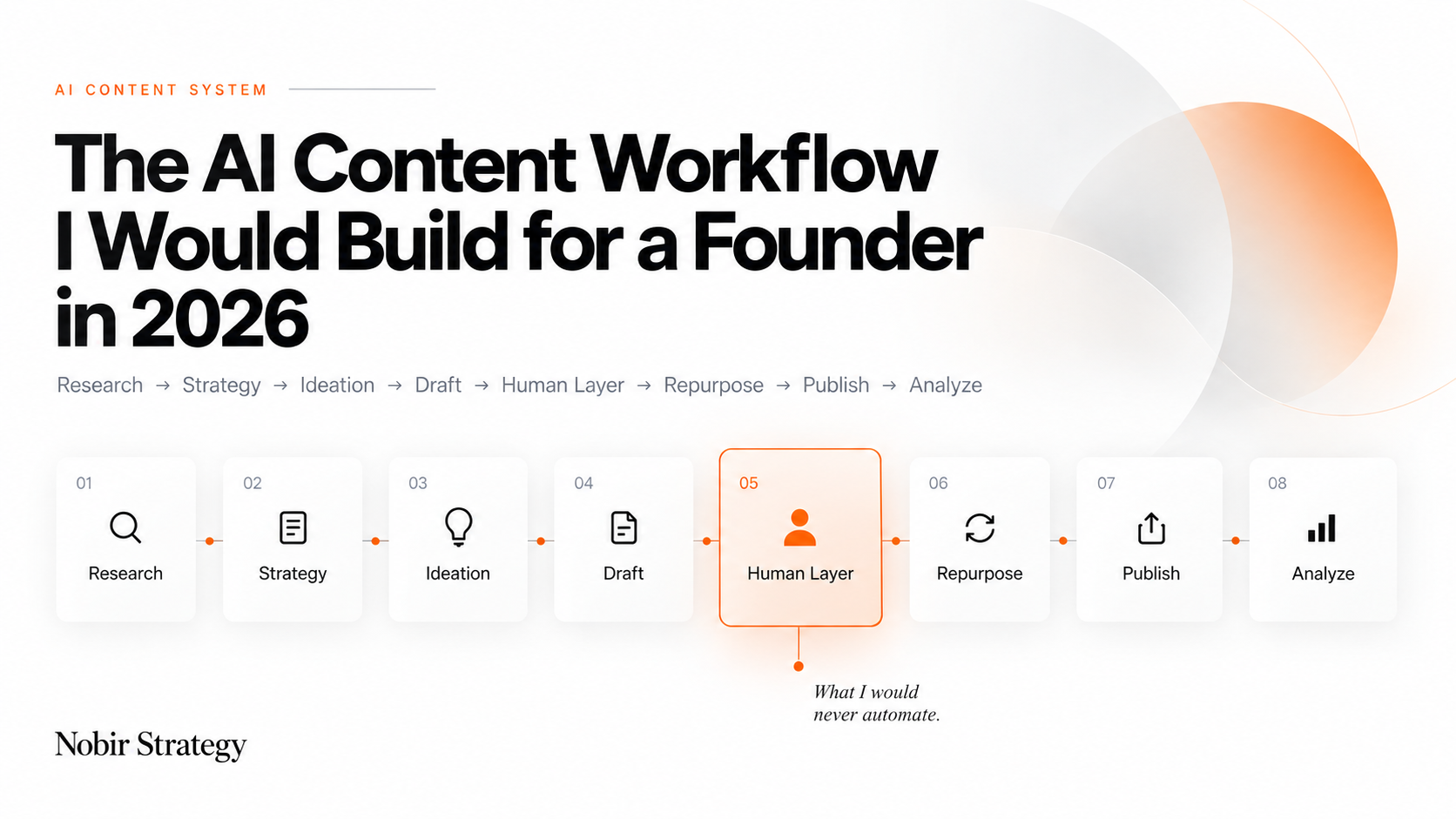
Research → Strategy → Ideation → Draft → Human Layer → Repurpose → Publish → Analyze
AI supports almost every stage.
But AI does not own every stage.
That distinction is the whole strategy.
The short answer: what should an AI content workflow look like in 2026?
A useful founder AI content workflow should use AI for information processing, exploration, drafting, transformation and repetitive operational work, while humans remain responsible for positioning, judgment, lived experience, factual responsibility, relationships and final editorial decisions.
My default workflow would be:
| Stage Main AI role Human responsibility Output | |||
| Research | Find, compare and organize information | Decide what is credible and relevant | Research brief |
| Strategy | Challenge assumptions and structure thinking | Choose audience, message and business goal | Strategic angle |
| Ideation | Expand possible angles | Choose ideas worth attaching your name to | Content ideas |
| Draft | Turn the brief into a strong first version | Supply expertise, proof and context | Working draft |
| Human Layer | Assist with editing if needed | Voice, story, nuance, judgment and truth | Publishable content |
| Repurpose | Transform approved ideas into formats | Protect meaning and platform relevance | Native assets |
| Publish | Handle routing and repetitive steps | Final approval | Live content |
| Analyze | Summarize patterns and performance | Interpret what those patterns actually mean | Next decision |
The important thing is not having every AI tool.
The important thing is having clear ownership at every stage.
1. Research: AI should shorten the distance between a question and the evidence
Most weak AI content begins with a weak input.
Someone asks:
“Write me a LinkedIn post about personal branding.”
The AI writes what it already knows.
The founder edits two sentences.
The post goes live.
Nothing in that process forced anyone to learn something.
A better workflow starts with research.
Before I generate content, I want to understand:
- What is changing in the market?
- What questions are buyers actually asking?
- What assumptions are being repeated?
- What evidence supports or challenges those assumptions?
- What has already been said hundreds of times?
- What does the founder know from experience that the search results do not?
That research becomes the raw material for the content.
Where I would use ChatGPT
I would use ChatGPT when I need to investigate a topic, compare multiple sources, organize messy research, identify contradictions or turn a broad question into a structured research brief.
ChatGPT Search can bring current web information into a conversation, while Deep Research is designed for multi-step investigation and produces reports with citations or source links. (openai.com)
That makes it useful for questions such as:
What are founders currently misunderstanding about AI content?
Or:
Compare current guidance from Google, LinkedIn, major AI platforms and recent research on AI-generated marketing content. Separate confirmed findings from opinions.
That is a much stronger starting point than “give me 20 content ideas.”
Where I would use Gemini
Gemini becomes particularly useful when the information I need already lives close to the Google ecosystem.
Gemini Deep Research can use Google Search by default and, depending on the user's setup, can also work with sources such as Drive and Gmail. Gemini can also analyze uploaded documents and other files. (support.google.com)
So imagine a founder has:
- customer research in Drive,
- sales notes,
- internal documents,
- industry reports,
- previous articles,
- survey responses.
The research question is no longer only:
“What does the internet say?”
It becomes:
“What does the market say, what do our customers say, and where is the gap between them?”
That gap is often where the best content starts.
Where Claude can fit
Claude also supports web research and can work from project knowledge and connected context. Anthropic describes its Research capability as performing multiple searches that build on one another, and Claude Projects can hold reference material and custom instructions for ongoing work. (anthropic.com)
I would not use three AI tools simply because three tools exist.
I would use a second research system when the topic is important enough to justify cross-checking, or when one platform has access to context the other does not.
The rule I would give every founder
AI can collect the evidence. You still have to decide what the evidence means.
A citation is not the same thing as understanding.
2. Strategy: do not let AI decide what your brand believes
Research gives you information.
Strategy tells you which information matters.
This is where many AI workflows break.
The founder researches a topic and immediately asks AI to write the post.
I would put a strategic layer in between.
Before content creation begins, I want six questions answered:
- Who specifically is this for?
- What situation are they currently in?
- What do they believe before consuming the content?
- What should they understand differently afterward?
- What evidence can support that shift?
- What business job should the content perform?
That final question matters.
Not every post needs to sell.
But every post should have a job.
One piece might create discovery.
Another might demonstrate expertise.
Another might handle an objection.
Another might give an existing follower a reason to start a conversation.
Another might move a warm buyer toward an offer.
That is why I separate content production from content strategy.
I explain the larger path from attention to business outcomes in my Content-to-Client System.
The point is simple:
Do not ask AI what you should believe. Ask it to pressure-test what you believe.
I might give ChatGPT or Claude a strategic position and say:
Challenge this argument. What evidence would weaken it? What would a smart buyer disagree with? Which parts are generic? What is missing?
That turns AI into a thinking partner rather than an outsourced strategist.
3. Ideation: AI should expand the idea space, not become the idea
AI is extremely useful for ideation.
But there is a trap.
When thousands of people give similar models similar prompts, they can start receiving similar patterns of answers.
Research on AI-assisted creativity reflects this tension. Experiments have found that ChatGPT assistance can improve the creativity of individual ideas, while subsequent analysis has raised concerns that AI-assisted brainstorming can reduce diversity across the overall pool of ideas. (nature.com)
That is exactly why I would not ask:
“Give me 30 viral content ideas.”
Instead, I would give the AI better raw material.
For example:
Audience: B2B service founder
Problem: Gets engagement but few qualified conversations
Evidence: Analytics, client conversations and sales objections
Point of view: Reach without trust creates attention, not demand
Business goal: Demonstrate content strategy expertise
Then I would ask for multiple angles:
- Contrarian angle
- Personal observation
- Tactical guide
- Mistake breakdown
- Case-based angle
- Buyer objection
- Before-and-after
- Framework
- Data-led explanation
- Story opening
Now AI is exploring my strategic territory instead of inventing the territory for me.
This is also where strong hooks begin.
A hook should package a real idea, not manufacture importance around a weak one. I break that process down further in Hook Engineering: How to Make People Stop Without Using Clickbait.
4. Draft: this is where I would use Claude or ChatGPT, but only after the thinking exists
I do not care which AI produces the prettier first sentence.
I care whether the draft is grounded in a strong brief.
For long-form drafting, I often want a workspace where I can provide:
- research,
- previous writing,
- voice guidelines,
- positioning,
- examples,
- banned phrases,
- audience context,
- source material.
Claude Projects can maintain project knowledge and instructions, while Artifacts provide a dedicated space for substantial documents and reusable content. (support.anthropic.com)
ChatGPT Projects similarly allow chats, files, instructions and project context to stay together instead of rebuilding the context for every new conversation. (openai.com)
Either can work.
The important improvement is moving from:
Prompt → Article
to:
Research → Strategy → Brief → Draft
The drafting brief I would give the AI
Before requesting the first draft, I would define:
Audience: Who exactly is reading?
Problem: What are they dealing with?
Objective: What should this piece achieve?
Core argument: What is the main idea?
Evidence: What sources or examples can be used?
Founder insight: What comes from actual experience?
Tone: How should it sound?
CTA: What should happen next?
Then I would tell the model:
Do not invent examples, results, experiences, quotes or statistics. Flag unsupported claims instead of filling the gap.
That sentence alone removes a large amount of bad AI writing.
5. The Human Layer: this is the stage most AI content systems are missing
The first AI draft is not the finished content.
It is material.
The human layer is where material becomes something worth publishing under a real person's name.
I would review the draft for five things.
Does this actually sound like the founder?
Not “professional.”
Not “well written.”
The founder.
Real people have preferences.
They repeat certain ideas.
They have specific ways of describing problems.
They disagree with things.
They have stories.
They use examples that come from doing the work.
AI can imitate surface-level tone.
It cannot manufacture genuine experience without inventing it.
Did we add something that search results cannot?
This matters more as AI-generated information becomes cheap.
Google's current guidance for generative AI search specifically emphasizes valuable, unique and non-commodity content rather than some separate “AI SEO” trick. Its broader people-first guidance asks whether content provides original information, analysis, research or additional value beyond simply rewriting other sources. (developers.google.com)
That means the founder's experience is not decoration.
It is part of the moat.
Are the claims defensible?
Every number should have a source.
Every quote should be confirmed.
Every example presented as real should actually be real.
If the evidence is uncertain, the writing should say so.
AI should make fact-checking easier.
It should not make false confidence easier.
Is there emotional truth?
Some content needs precision.
Some content needs personality.
Some needs vulnerability.
Some needs conviction.
A model can help shape those things, but the founder must decide what they genuinely want to say.
Research in social media marketing has found that perceptions of AI use can reduce perceived brand authenticity, while negative effects were weaker when AI assisted humans rather than replaced them completely. That does not mean “never use AI.” It means the human role is strategically important, especially when trust is the product. (sciencedirect.com)
Would I say this in front of a client?
This is one of my favorite editorial tests.
If the answer is no, I do not publish it just because the sentence looks smart on LinkedIn.
6. Repurpose: turn one idea into multiple native expressions, not multiple copies
Once an idea has passed the human layer, AI becomes extremely useful again.
The expensive part is often not converting an article into a carousel.
The expensive part is developing the original insight.
Once that insight is strong, it can become:
- A LinkedIn post
- A carousel
- A short video script
- A newsletter section
- A Threads post
- A founder quote
- A visual framework
- A sales-enablement asset
- A follow-up post answering objections
But I would never tell AI:
“Turn this into every platform.”
Not without additional instructions.
Each platform changes the packaging.
A LinkedIn opening does not automatically become a strong Reel opening.
A 2,000-word article does not become a good carousel simply because it was divided into ten slides.
Repurposing should preserve the idea while changing the delivery.
That is one reason I prefer thinking in terms of a content operating system rather than a calendar. A calendar organizes publishing dates. An operating system connects research, strategy, creation, distribution, measurement and learning. I explore that distinction in Content Calendar vs Content Operating System.
7. Where Canva belongs: execution, not strategic authority
Canva belongs after the content idea is clear.
Not before.
I would use it to translate approved ideas into:
- Carousels
- Diagrams
- Presentation graphics
- Quote graphics
- Short-form visual assets
- Thumbnails
- Branded content variations
Canva has continued expanding AI-assisted creation, including its newer conversational and editable design capabilities. (canva.com)
That can remove a huge amount of production friction.
But Canva should not decide what the founder's positioning is.
A beautiful graphic containing a commodity idea is still commodity content.
The strategic sequence should be:
Idea → Message → Structure → Design
Not:
Template → Fill the empty boxes → Publish
8. Automation: automate movement, not meaning
This is where I think many founders over-automate.
Automation is excellent for moving information between systems.
For example:
Approved draft → content database
Approved carousel → publishing queue
Published asset → analytics tracker
New performance data → weekly report
New customer question → idea database
Those are operational handoffs.
The system already knows what should happen.
That is exactly where automation creates leverage.
What I do not want is an automation that goes:
Trend detected → AI generates opinion → AI designs graphic → AI publishes founder opinion
with no serious review in between.
The technical system worked.
The brand system failed.
Modern automation platforms increasingly support approval checkpoints for exactly this reason. Zapier's Human in the Loop features, for example, can pause a workflow so someone can review, edit, approve or reject AI-generated content before higher-impact actions such as publishing continue. (help.zapier.com)
That is much closer to the architecture I want:
Automation → Human Gate → Automation
not:
Automation → Automation → Automation → Regret
9. Publish: the founder should still own the final decision
Publishing feels operational.
For a founder-led brand, it is not completely operational.
Every published idea teaches the market something about:
- What you believe
- What you understand
- Who you serve
- What you prioritize
- What you are willing to stand behind
That means the final approval matters.
For low-risk content, approval can be quick.
For strong opinions, client stories, claims, sensitive subjects or anything tied closely to reputation, review should become stricter.
I would automate:
Scheduling.
Asset routing.
Metadata.
Notifications.
Status changes.
Reporting.
I would not automate accountability.
10. Analyze: do not ask AI only what performed best
Once content is published, the workflow should loop back to the beginning.
AI is useful for summarizing performance across large amounts of content.
It can help identify:
- Repeated high-performing topics
- Hook patterns
- Formats associated with stronger response
- Comment themes
- Buyer questions
- Underperforming content clusters
- Potential follow-up ideas
But the founder or strategist still needs to ask the business question.
A post can reach 500,000 people and still attract the wrong audience.
A post can reach 10,000 people and generate multiple relevant conversations.
Those are not the same outcome.
One of the strongest lessons from my own work came from seeing content reach 30.8 million views in 28 days and realizing that virality and trust are different problems.
I explain that lesson in 30.8 Million Views Taught Me This: Virality Does Not Automatically Build Trust.
That is why my analytics loop would not stop at:
Which post received the most views?
I would also ask:
Which content attracted the people we actually want?
Which ideas created meaningful conversations?
Which content increased profile exploration?
Which objections appeared repeatedly?
Which ideas were remembered?
Which content brought someone closer to becoming a buyer?
The output of analytics should not be another dashboard.
It should be the next strategic decision.
So where exactly does each AI tool belong?
Here is the simple version.
ChatGPT
I would primarily use ChatGPT for:
Research synthesis, strategic exploration, challenging assumptions, idea expansion, structured analysis, repurposing and ongoing project work.
Its Search and Deep Research capabilities make it particularly useful when current external information and citations matter. (openai.com)
Claude
I would primarily use Claude for:
Working with substantial source material, developing and refining long-form drafts, maintaining project context and iterating on standalone documents.
Projects and Artifacts make this type of ongoing document workflow practical. (support.anthropic.com)
Gemini
I would primarily use Gemini for:
Research that benefits from Google Search or connected Google context, analyzing source files and creating repeatable research or working setups through features such as Deep Research and Gems. (support.google.com)
Canva
I would use Canva after the idea is strategically approved.
Its job is to help turn ideas into strong visual communication and reusable creative assets.
It should accelerate design.
It should not replace positioning.
Automation
I would use automation for:
Routing, moving data, updating databases, scheduling, status changes, notifications, analytics collection and other repeatable processes.
Where reputation or accuracy is involved, I would add approval gates.
Human judgment
Human judgment sits across the entire system.
Not only at the end.
The founder decides:
What matters.
What is true.
What is worth saying.
What represents their experience.
What the evidence actually means.
What the audience needs.
What the brand should stand for.
And what never gets published.
What I would never automate
This is the part of the AI content workflow I care about most.
Because the question is no longer:
What can AI automate?
Technically, the answer keeps getting larger.
The better question is:
What becomes less valuable when we automate it?
1. I would never automate the founder's point of view
AI can challenge a belief.
It can research it.
It can find counterarguments.
It can help explain it.
But if the point of view exists only because the AI suggested it, you are not building thought leadership.
You are renting one.
2. I would never automate lived experience
AI should never invent the sales call that never happened.
The client lesson you never learned.
The failure you never experienced.
The result you never produced.
Or the emotion you never felt.
A less dramatic true story is more valuable than a powerful fabricated one.
3. I would never automate factual responsibility
The model may help locate the source.
The model may summarize it.
But when my name goes on the claim, I am responsible for checking it.
That responsibility cannot be delegated to autocomplete.
4. I would never fully automate relationship moments
A high-intent comment from a buyer.
A frustrated customer.
A sensitive DM.
A public complaint.
A client conversation.
These interactions carry context that goes beyond efficiency.
AI can help prepare a response.
A human should understand the person before sending it.
5. I would never automate the final judgment on reputation-sensitive content
Could the workflow technically publish automatically?
Yes.
Would I always let it?
No.
The closer content gets to reputation, trust, claims, personal stories or strong opinions, the more human review matters.
6. I would never automate the interpretation of what the audience means
Analytics can tell you what happened.
AI can summarize patterns.
Neither automatically knows why someone trusted you.
Why an idea changed a buyer's mind.
Why qualified people ignored a high-performing post.
Why a small post started three serious sales conversations.
That interpretation comes from combining data with customer knowledge and business judgment.
The minimal AI stack I would actually give most founders
A founder does not need every new AI product.
For many teams, I would rather see four clearly defined layers:
One research and thinking environment
ChatGPT, Claude or Gemini.
One place for content knowledge
Your project workspace, knowledge base or content operating system.
One visual production environment
For many teams, Canva can cover a large part of this layer.
One automation layer
Used only after the process itself is stable.
You may eventually use more tools.
But every new tool should solve a bottleneck.
It should not become another bottleneck.
The deeper advantage is not speed
AI makes content production faster.
That is obvious.
But speed alone will not remain a competitive advantage when everyone has access to similar speed.
The advantage shifts somewhere else.
To better questions.
Better source material.
Better customer understanding.
Better judgment.
Better stories.
Better positioning.
Better taste.
Better systems for learning from what happens after publishing.
This is why I do not believe the future belongs to the founder who can generate the most content.
It belongs to the founder who can use AI to remove low-value work while becoming more human where being human matters.
That is a very different content strategy.
The workflow in one sentence
Use AI to research faster, think wider, draft sooner, repurpose efficiently and remove repetitive work, but keep positioning, experience, truth, relationships and final judgment human.
That is the AI content workflow I would build for a founder in 2026.
Not a content factory.
A decision system.
Frequently Asked Questions
What is the best AI tool for a founder's content workflow?
There is no single best tool for every stage. I would choose tools based on the job. ChatGPT, Claude and Gemini can overlap significantly, so a founder does not need all three simply because they exist. Start with the bottleneck you are solving, then add tools only when they create a meaningful advantage.
Can AI-generated or AI-assisted content rank on Google?
AI use by itself is not the deciding issue. Google's guidance focuses on whether content is helpful, reliable, people-first and compliant with Search policies. Using automation primarily to manipulate search rankings can violate spam policies. (developers.google.com)
For Google's AI features such as AI Overviews and AI Mode, there is no separate secret technical requirement. Google says pages must first be indexed and eligible to appear in Search with a snippet, while normal SEO and content-quality practices continue to apply. (developers.google.com)
Should founders automatically publish AI-generated content?
For low-risk workflows, automation can remove operational work. For founder-led content, I prefer a human approval gate before publication, especially when the content includes claims, opinions, customer stories or anything reputation-sensitive.
Where should the human spend the most time?
Not on formatting.
Spend human attention on customer understanding, positioning, original insight, lived experience, source verification, storytelling, judgment and interpreting what performance data means for the business.
How many AI tools does a founder really need?
Usually fewer than the internet suggests.
The workflow matters more than the tool count.
If one AI workspace, one design environment and one simple operational system handle your current bottlenecks, adding another application will not automatically improve the content.
About the Author
Nobir Hossen is a Meta-certified Social Media Strategist focused on content systems, audience psychology, organic growth and AI-assisted content workflows.
Across 3+ years and 35+ projects, his work has contributed to more than 300M organic views across brands and content ecosystems.
His approach is strategy-first: build content that earns attention, converts attention into trust, and gives the right audience a clear path toward becoming a client.
If your team is producing content but the process still feels scattered, you can also explore my AI Content Workflows and Social Media Strategy services.
Sources & Further Reading
Google Search Central: Creating Helpful, Reliable, People-First Content
Google's official guidance on original value, authorship, AI-assisted content and people-first publishing. Read the Google guidance
Google Search Central: Optimizing for Generative AI Features
Official 2026 guidance for Google AI Overviews and AI Mode visibility. Read the AI Search guide
Google Search Central: AI Features and Your Website
Technical eligibility and Search requirements for AI features. Read Google's AI features documentation
OpenAI: Research with ChatGPT
Official guidance covering ChatGPT Search and Deep Research. Explore the OpenAI research guide
Anthropic: Claude Research
Anthropic's documentation on Claude's research workflow and connected context. Explore Claude Research
Google: Gemini Deep Research
Official documentation covering Deep Research and its available source options. Explore Gemini Deep Research
Canva: Canva AI 2.0
Canva's current direction for AI-assisted, editable visual creation. Explore Canva AI 2.0
Nature Human Behaviour: AI and Creativity
Research and follow-up analysis examining the benefits and diversity trade-offs of AI-assisted brainstorming. (nature.com)
Journal of Retailing and Consumer Services: AI Content and Brand Authenticity
Experimental research examining how AI-generated versus AI-assisted social content can affect perceived brand authenticity. Read the research summary
Zapier: Human in the Loop
Documentation showing how automated workflows can pause for review and approval before continuing. Read the Human in the Loop documentation